

Give the Gift of Choice!
Too many options? Treat your friends and family to their favourite stores with a Bayshore Shopping Centre gift card, redeemable at participating retailers throughout the centre. Click below to purchase yours today!Purchase HereHome
Bandwidth Extension of Speech Using Perceptual Criteria
Coles
Loading Inventory...
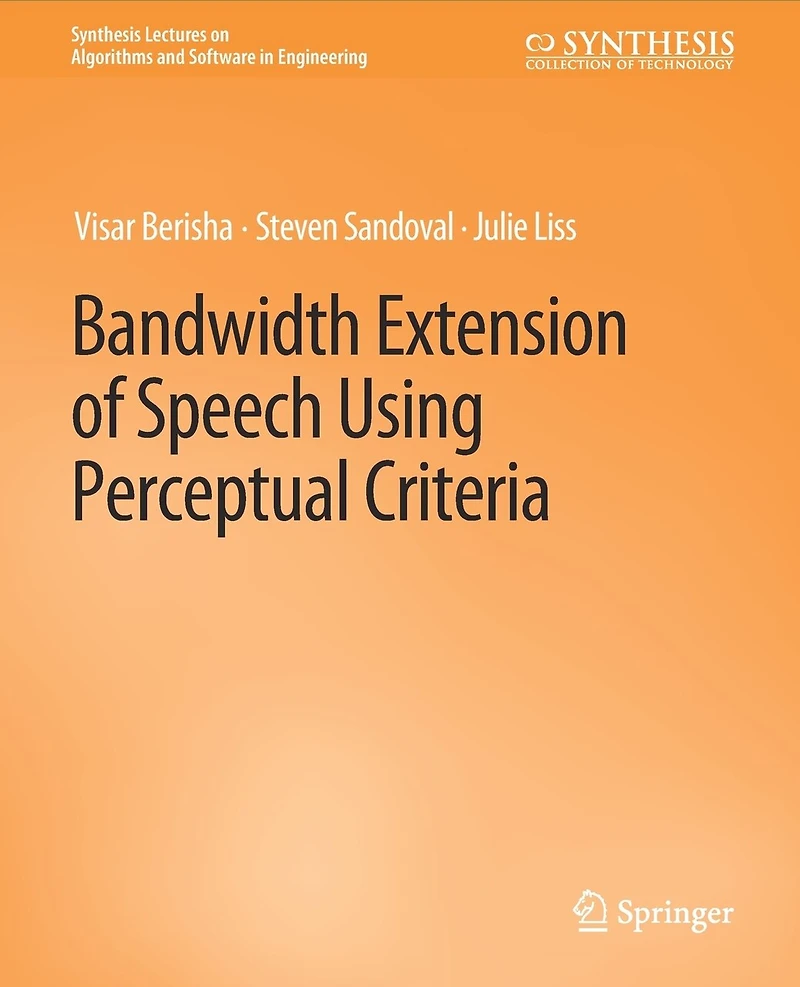
Bandwidth Extension of Speech Using Perceptual Criteria in Ottawa, ON
By None
Current price: $38.95

By None
Bandwidth Extension of Speech Using Perceptual Criteria in Ottawa, ON
Current price: $38.95
Loading Inventory...
Size: Paperback
*Product information may vary - to confirm product availability, pricing, shipping and return information please contact Coles
Bandwidth extension of speech is used in the International Telecommunication Union G.729.1 standard in which the narrowband bitstream is combined with quantized high-band parameters. Although this system produces high-quality wideband speech, the additional bits used to represent the high band can be further reduced. In addition to the algorithm used in the G.729.1 standard, bandwidth extension methods based on spectrum prediction have also been proposed. Although these algorithms do not require additional bits, they perform poorly when the correlation between the low and the high band is weak. In this book, two wideband speech coding algorithms that rely on bandwidth extension are developed. The algorithms operate as wrappers around existing narrowband compression schemes. More specifically, in these algorithms, the low band is encoded using an existing toll-quality narrowband system, whereas the high band is generated using the proposed extension techniques. The first method relies only on transmitted high-band information to generate the wideband speech. The second algorithm uses a constrained minimum mean square error estimator that combines transmitted high-band envelope information with a predictive scheme driven by narrowband features. Both algorithms make use of novel perceptual models based on loudness that determine optimum quantization strategies for wideband recovery and synthesis. Objective and subjective evaluations reveal that the proposed system performs at a lower average bit rate while improving speech quality when compared to other similar algorithms.
Bandwidth extension of speech is used in the International Telecommunication Union G.729.1 standard in which the narrowband bitstream is combined with quantized high-band parameters. Although this system produces high-quality wideband speech, the additional bits used to represent the high band can be further reduced. In addition to the algorithm used in the G.729.1 standard, bandwidth extension methods based on spectrum prediction have also been proposed. Although these algorithms do not require additional bits, they perform poorly when the correlation between the low and the high band is weak. In this book, two wideband speech coding algorithms that rely on bandwidth extension are developed. The algorithms operate as wrappers around existing narrowband compression schemes. More specifically, in these algorithms, the low band is encoded using an existing toll-quality narrowband system, whereas the high band is generated using the proposed extension techniques. The first method relies only on transmitted high-band information to generate the wideband speech. The second algorithm uses a constrained minimum mean square error estimator that combines transmitted high-band envelope information with a predictive scheme driven by narrowband features. Both algorithms make use of novel perceptual models based on loudness that determine optimum quantization strategies for wideband recovery and synthesis. Objective and subjective evaluations reveal that the proposed system performs at a lower average bit rate while improving speech quality when compared to other similar algorithms.
You May Also Like









More About Coles at Bayshore Shopping Centre
Coles is renowned for its outstanding customer service and great selection of books. Along with the vast array of magazines, stationary, audio-books, children's literature, fiction, non-fiction and reference books, you can find accessories to make your reading experience more pleasurable. We can recommend the very best in reading today. We will help you search our titles for exactly what you need, and if we do not have it in stock, we will order it for you.
100 Bayshore Dr, Nepean, ON K2B 8C1, Canada
Find Coles at Bayshore Shopping Centre in Ottawa, ON
Visit Coles at Bayshore Shopping Centre in Ottawa, ON