

Give the Gift of Choice!
Too many options? Treat your friends and family to their favourite stores with a Bayshore Shopping Centre gift card, redeemable at participating retailers throughout the centre. Click below to purchase yours today!Purchase HereHome
Complement Methods and Protocols by B. Paul Morgan, Hardcover | Indigo Chapters
Coles
Loading Inventory...
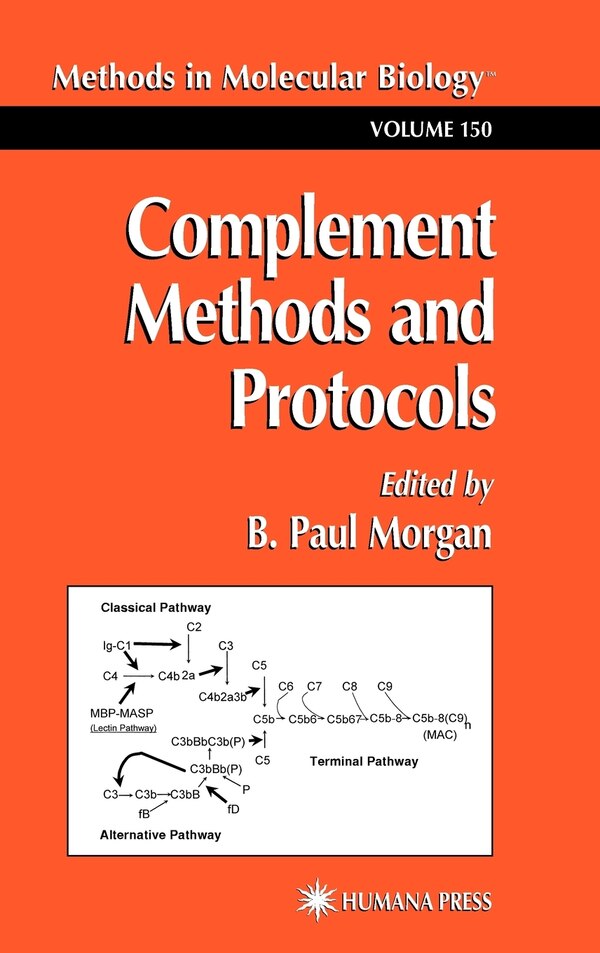
Complement Methods and Protocols by B. Paul Morgan, Hardcover | Indigo Chapters in Ottawa, ON
By B. Paul Morgan
Current price: $248.50

By B. Paul Morgan
Complement Methods and Protocols by B. Paul Morgan, Hardcover | Indigo Chapters in Ottawa, ON
Current price: $248.50
Loading Inventory...
Size: 1 x 9.02 x 2.69
*Product information may vary - to confirm product availability, pricing, shipping and return information please contact Coles
The complement system, first described more than a century ago, was for many years the ugly duckling of the immunology world, but no more. Complement in recent years has blossomed into a fascinating and fast moving field of immediate relevance to clinical scientists in fields as diverse as transplantation biology, virology, and inflammation. Despite its emergence from the shadows, complement retains an unwarranted reputation for being difficult. This impression derives in large part from the superficially complicated nomenclature, a relic of the long and tortuous process of unraveling the system, of naming components in order of discovery rather than in a syst- atic manner. Once the barrier of nomenclature has been surmounted, then the true simplicity of the system becomes apparent. Complement comprises an activation system and a cytolytic system. The former has diverged to focus on complement to distinct targets-bacteria, - mune complexes, and others-so that texts now describe three activation pa- ways, closely related to one another, but each with some unique features. The cytolytic pathway is the same regardless of the activation process and kills cells by creating pores in the membrane. Complement plays an important role in killing bacteria and is essential for the proper handling of immune complexes. Problems occur when complement is activated in an inappropriate manner-the potent inflammation-inducing products of the cascade then cause unwanted tissue damage and destruction. | Complement Methods and Protocols by B. Paul Morgan, Hardcover | Indigo Chapters
The complement system, first described more than a century ago, was for many years the ugly duckling of the immunology world, but no more. Complement in recent years has blossomed into a fascinating and fast moving field of immediate relevance to clinical scientists in fields as diverse as transplantation biology, virology, and inflammation. Despite its emergence from the shadows, complement retains an unwarranted reputation for being difficult. This impression derives in large part from the superficially complicated nomenclature, a relic of the long and tortuous process of unraveling the system, of naming components in order of discovery rather than in a syst- atic manner. Once the barrier of nomenclature has been surmounted, then the true simplicity of the system becomes apparent. Complement comprises an activation system and a cytolytic system. The former has diverged to focus on complement to distinct targets-bacteria, - mune complexes, and others-so that texts now describe three activation pa- ways, closely related to one another, but each with some unique features. The cytolytic pathway is the same regardless of the activation process and kills cells by creating pores in the membrane. Complement plays an important role in killing bacteria and is essential for the proper handling of immune complexes. Problems occur when complement is activated in an inappropriate manner-the potent inflammation-inducing products of the cascade then cause unwanted tissue damage and destruction. | Complement Methods and Protocols by B. Paul Morgan, Hardcover | Indigo Chapters
You May Also Like













More About Coles at Bayshore Shopping Centre
Coles is renowned for its outstanding customer service and great selection of books. Along with the vast array of magazines, stationary, audio-books, children's literature, fiction, non-fiction and reference books, you can find accessories to make your reading experience more pleasurable. We can recommend the very best in reading today. We will help you search our titles for exactly what you need, and if we do not have it in stock, we will order it for you.
100 Bayshore Dr, Nepean, ON K2B 8C1, Canada
Find Coles at Bayshore Shopping Centre in Ottawa, ON
Visit Coles at Bayshore Shopping Centre in Ottawa, ON