

Give the Gift of Choice!
Too many options? Treat your friends and family to their favourite stores with a Bayshore Shopping Centre gift card, redeemable at participating retailers throughout the centre. Click below to purchase yours today!Purchase HereHome
Congruences for L-Functions
Coles
Loading Inventory...
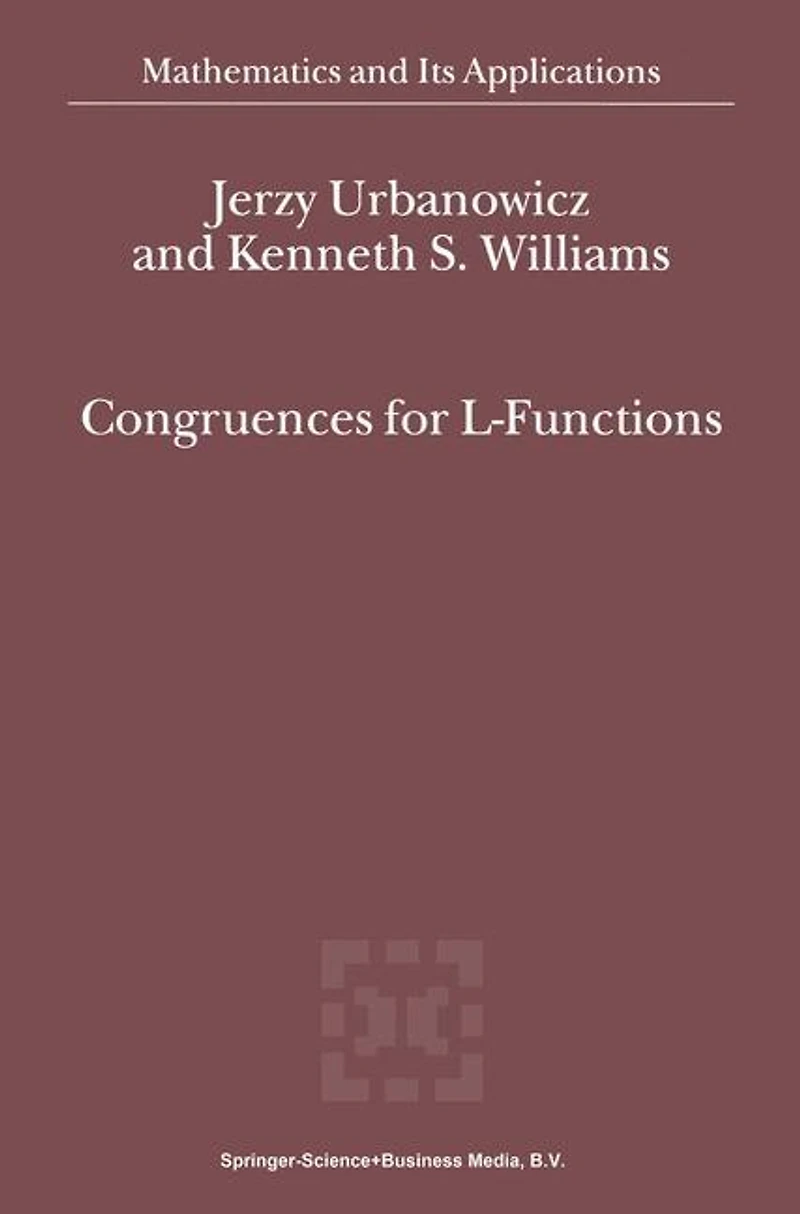
Congruences for L-Functions in Ottawa, ON
Current price: $80.50

Congruences for L-Functions in Ottawa, ON
Current price: $80.50
Loading Inventory...
Size: Paperback
*Product information may vary - to confirm product availability, pricing, shipping and return information please contact Coles
In [Hardy and Williams, 1986] the authors exploited a very simple idea to obtain a linear congruence involving class numbers of imaginary quadratic fields modulo a certain power of 2. Their congruence provided a unified setting for many congruences proved previously by other authors using various means. The Hardy-Williams idea was as follows. Let d be the discriminant of a quadratic field. Suppose that d is odd and let d = PIP2- . . Pn be its unique decomposition into prime discriminants. Then, for any positive integer k coprime with d, the congruence holds trivially as each Legendre-Jacobi-Kronecker symbol (<) has the value + 1 or -1. Expanding this product gives < eld e:=l (mod4) where e runs through the positive and negative divisors of d and v (e) denotes the number of distinct prime factors of e. Summing this congruence for o < k < Idl/8, gcd(k, d) = 1, gives < (-It(e) < (<) =:O(mod2n). eld o
In [Hardy and Williams, 1986] the authors exploited a very simple idea to obtain a linear congruence involving class numbers of imaginary quadratic fields modulo a certain power of 2. Their congruence provided a unified setting for many congruences proved previously by other authors using various means. The Hardy-Williams idea was as follows. Let d be the discriminant of a quadratic field. Suppose that d is odd and let d = PIP2- . . Pn be its unique decomposition into prime discriminants. Then, for any positive integer k coprime with d, the congruence holds trivially as each Legendre-Jacobi-Kronecker symbol (<) has the value + 1 or -1. Expanding this product gives < eld e:=l (mod4) where e runs through the positive and negative divisors of d and v (e) denotes the number of distinct prime factors of e. Summing this congruence for o < k < Idl/8, gcd(k, d) = 1, gives < (-It(e) < (<) =:O(mod2n). eld o
You May Also Like













More About Coles at Bayshore Shopping Centre
Coles is renowned for its outstanding customer service and great selection of books. Along with the vast array of magazines, stationary, audio-books, children's literature, fiction, non-fiction and reference books, you can find accessories to make your reading experience more pleasurable. We can recommend the very best in reading today. We will help you search our titles for exactly what you need, and if we do not have it in stock, we will order it for you.
100 Bayshore Dr, Nepean, ON K2B 8C1, Canada
Find Coles at Bayshore Shopping Centre in Ottawa, ON
Visit Coles at Bayshore Shopping Centre in Ottawa, ON