

Give the Gift of Choice!
Too many options? Treat your friends and family to their favourite stores with a Bayshore Shopping Centre gift card, redeemable at participating retailers throughout the centre. Click below to purchase yours today!Purchase HereHome
Conservation Laws And Symmetry: Applications To Economics And Finance
Coles
Loading Inventory...
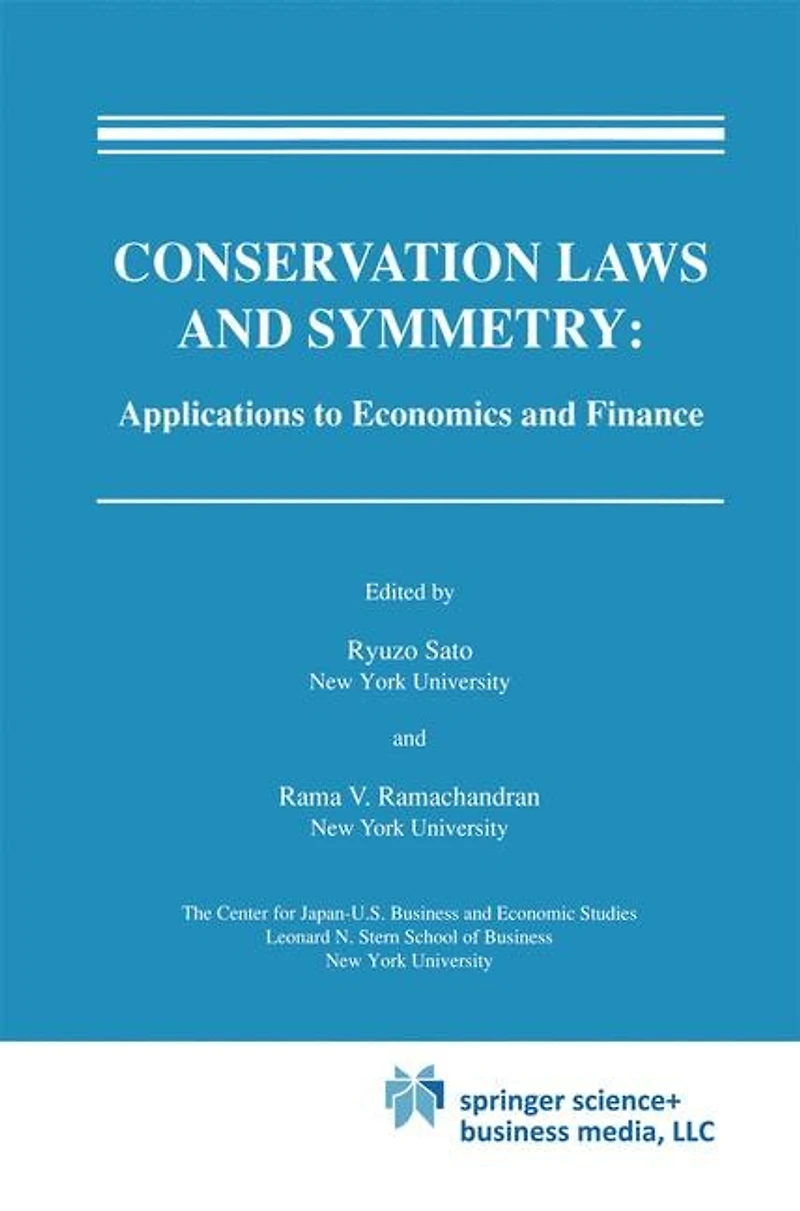
Conservation Laws And Symmetry: Applications To Economics And Finance in Ottawa, ON
Current price: $248.50

Conservation Laws And Symmetry: Applications To Economics And Finance in Ottawa, ON
Current price: $248.50
Loading Inventory...
Size: Paperback
*Product information may vary - to confirm product availability, pricing, shipping and return information please contact Coles
Modem geometric methods combine the intuitiveness of spatial visualization with the rigor of analytical derivation. Classical analysis is shown to provide a foundation for the study of geometry while geometrical ideas lead to analytical concepts of intrinsic beauty. Arching over many subdisciplines of mathematics and branching out in applications to every quantitative science, these methods are, notes the Russian mathematician A.T. Fomenko, in tune with the Renais sance traditions. Economists and finance theorists are already familiar with some aspects of this synthetic tradition. Bifurcation and catastrophe theo ries have been used to analyze the instability of economic models. Differential topology provided useful techniques for deriving results in general equilibrium analysis. But they are less aware of the central role that Felix Klein and Sophus Lie gave to group theory in the study of geometrical systems. Lie went on to show that the special methods used in solving differential equations can be classified through the study of the invariance of these equations under a continuous group of transformations. Mathematicians and physicists later recognized the relation between Lie's work on differential equations and symme try and, combining the visions of Hamilton, Lie, Klein and Noether, embarked on a research program whose vitality is attested by the innumerable books and articles written by them as well as by biolo gists, chemists and philosophers.
Modem geometric methods combine the intuitiveness of spatial visualization with the rigor of analytical derivation. Classical analysis is shown to provide a foundation for the study of geometry while geometrical ideas lead to analytical concepts of intrinsic beauty. Arching over many subdisciplines of mathematics and branching out in applications to every quantitative science, these methods are, notes the Russian mathematician A.T. Fomenko, in tune with the Renais sance traditions. Economists and finance theorists are already familiar with some aspects of this synthetic tradition. Bifurcation and catastrophe theo ries have been used to analyze the instability of economic models. Differential topology provided useful techniques for deriving results in general equilibrium analysis. But they are less aware of the central role that Felix Klein and Sophus Lie gave to group theory in the study of geometrical systems. Lie went on to show that the special methods used in solving differential equations can be classified through the study of the invariance of these equations under a continuous group of transformations. Mathematicians and physicists later recognized the relation between Lie's work on differential equations and symme try and, combining the visions of Hamilton, Lie, Klein and Noether, embarked on a research program whose vitality is attested by the innumerable books and articles written by them as well as by biolo gists, chemists and philosophers.
You May Also Like














More About Coles at Bayshore Shopping Centre
Coles is renowned for its outstanding customer service and great selection of books. Along with the vast array of magazines, stationary, audio-books, children's literature, fiction, non-fiction and reference books, you can find accessories to make your reading experience more pleasurable. We can recommend the very best in reading today. We will help you search our titles for exactly what you need, and if we do not have it in stock, we will order it for you.
100 Bayshore Dr, Nepean, ON K2B 8C1, Canada
Find Coles at Bayshore Shopping Centre in Ottawa, ON
Visit Coles at Bayshore Shopping Centre in Ottawa, ON