

Give the Gift of Choice!
Too many options? Treat your friends and family to their favourite stores with a Bayshore Shopping Centre gift card, redeemable at participating retailers throughout the centre. Click below to purchase yours today!Purchase HereHome
Differential Geometry: Connections, Curvature, And Characteristic Classes
Coles
Loading Inventory...
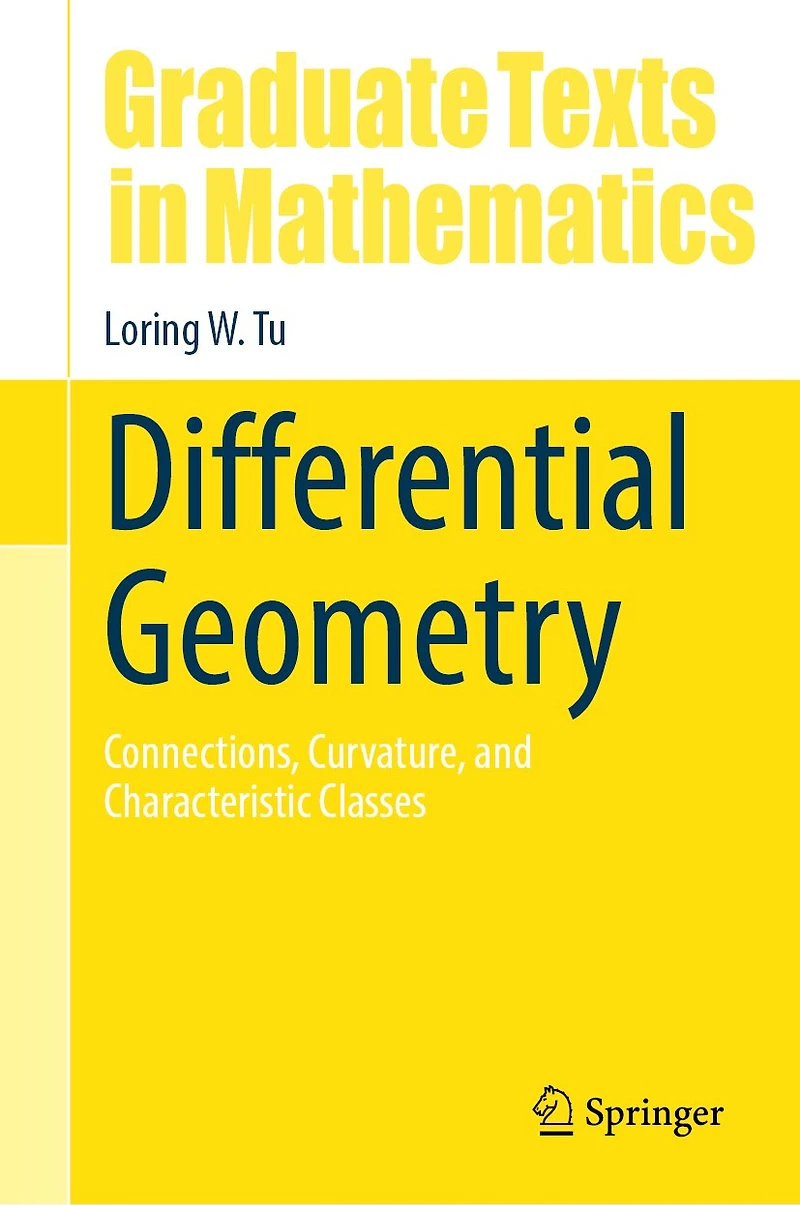
Differential Geometry: Connections, Curvature, And Characteristic Classes in Ottawa, ON
Current price: $102.50

Differential Geometry: Connections, Curvature, And Characteristic Classes in Ottawa, ON
Current price: $102.50
Loading Inventory...
Size: Hardcover
*Product information may vary - to confirm product availability, pricing, shipping and return information please contact Coles
This text presents a graduate-level introduction to differential geometry for mathematics and physics students. The exposition follows the historical development of the concepts of connection and curvature with the goal of explaining the Chern-Weil theory of characteristic classes on a principal bundle. Along the way we encounter some of the high points in the history of differential geometry, for example, Gauss' Theorema Egregium and the Gauss-Bonnet theorem. Exercises throughout the book test the reader's understanding of the material and sometimes illustrate extensions of the theory. Initially, the prerequisites for the reader include a passing familiarity with manifolds. After the first chapter, it becomes necessary to understand and manipulate differential forms. A knowledge of de Rham cohomology is required for the last third of the text. Prerequisite material is contained in author's text An Introduction to Manifolds , and can be learned in one semester. For the benefit of the reader and to establish common notations, Appendix A recalls the basics of manifold theory. Additionally, in an attempt to make the exposition more self-contained, sections on algebraic constructions such as the tensor product and the exterior power are included. Differential geometry, as its name implies, is the study of geometry using differential calculus. It dates back to Newton and Leibniz in the seventeenth century, but it was not until the nineteenth century, with the work of Gauss on surfaces and Riemann on the curvature tensor, that differential geometry flourished and its modern foundation was laid. Over the past one hundred years, differential geometry has proven indispensable to an understanding of the physical world, in Einstein's general theory of relativity, in the theory of gravitation, in gauge theory, and now in string theory. Differential geometry is also useful in topology, several complex variables, algebraic geometry, complex manifolds, and dynamical systems, among other fields. The field has even found applications to group theory as in Gromov's work and to probability theory as in Diaconis's work. It is not too far-fetched to argue that differential geometry should be in every mathematician's arsenal.
This text presents a graduate-level introduction to differential geometry for mathematics and physics students. The exposition follows the historical development of the concepts of connection and curvature with the goal of explaining the Chern-Weil theory of characteristic classes on a principal bundle. Along the way we encounter some of the high points in the history of differential geometry, for example, Gauss' Theorema Egregium and the Gauss-Bonnet theorem. Exercises throughout the book test the reader's understanding of the material and sometimes illustrate extensions of the theory. Initially, the prerequisites for the reader include a passing familiarity with manifolds. After the first chapter, it becomes necessary to understand and manipulate differential forms. A knowledge of de Rham cohomology is required for the last third of the text. Prerequisite material is contained in author's text An Introduction to Manifolds , and can be learned in one semester. For the benefit of the reader and to establish common notations, Appendix A recalls the basics of manifold theory. Additionally, in an attempt to make the exposition more self-contained, sections on algebraic constructions such as the tensor product and the exterior power are included. Differential geometry, as its name implies, is the study of geometry using differential calculus. It dates back to Newton and Leibniz in the seventeenth century, but it was not until the nineteenth century, with the work of Gauss on surfaces and Riemann on the curvature tensor, that differential geometry flourished and its modern foundation was laid. Over the past one hundred years, differential geometry has proven indispensable to an understanding of the physical world, in Einstein's general theory of relativity, in the theory of gravitation, in gauge theory, and now in string theory. Differential geometry is also useful in topology, several complex variables, algebraic geometry, complex manifolds, and dynamical systems, among other fields. The field has even found applications to group theory as in Gromov's work and to probability theory as in Diaconis's work. It is not too far-fetched to argue that differential geometry should be in every mathematician's arsenal.
You May Also Like







More About Coles at Bayshore Shopping Centre
Coles is renowned for its outstanding customer service and great selection of books. Along with the vast array of magazines, stationary, audio-books, children's literature, fiction, non-fiction and reference books, you can find accessories to make your reading experience more pleasurable. We can recommend the very best in reading today. We will help you search our titles for exactly what you need, and if we do not have it in stock, we will order it for you.
100 Bayshore Dr, Nepean, ON K2B 8C1, Canada
Find Coles at Bayshore Shopping Centre in Ottawa, ON
Visit Coles at Bayshore Shopping Centre in Ottawa, ON