

Give the Gift of Choice!
Too many options? Treat your friends and family to their favourite stores with a Bayshore Shopping Centre gift card, redeemable at participating retailers throughout the centre. Click below to purchase yours today!Purchase HereHome
Dynamic Models Of The Firm: Determining Optimal Investment, Financing And Production Policies By Computer
Coles
Loading Inventory...
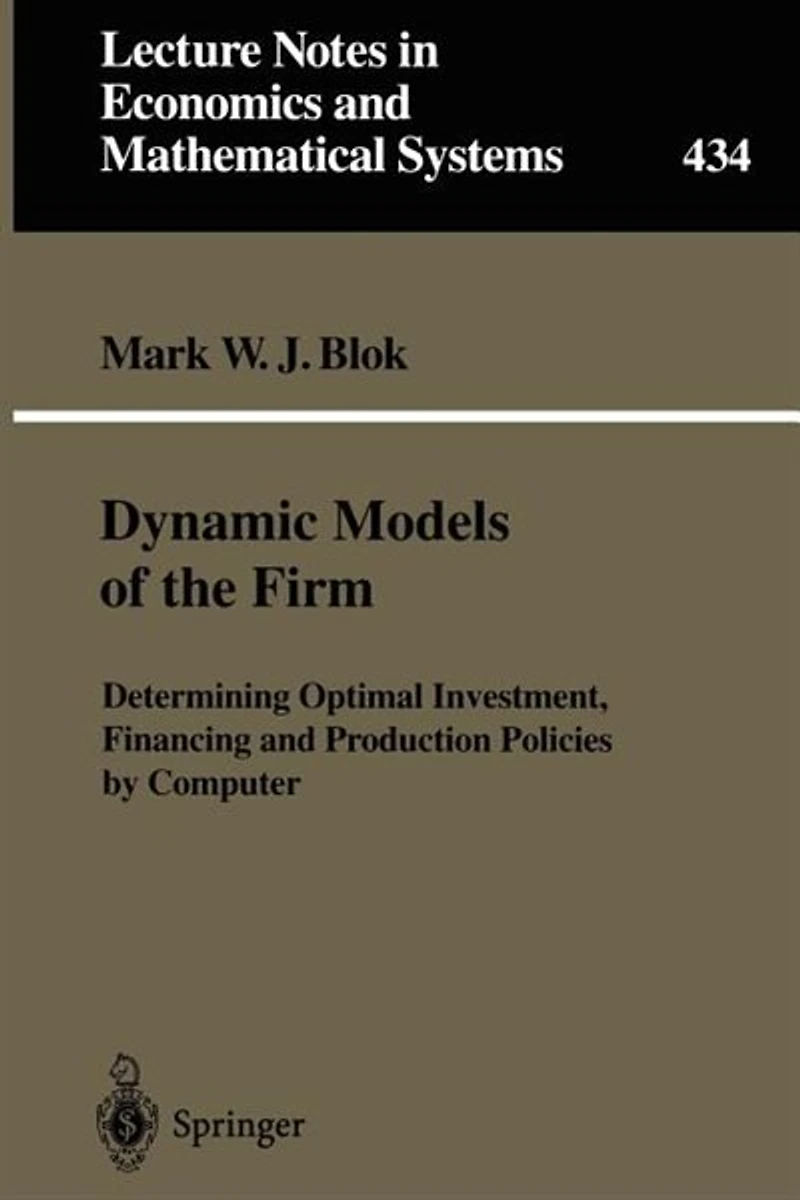
Dynamic Models Of The Firm: Determining Optimal Investment, Financing And Production Policies By Computer in Ottawa, ON
Current price: $71.50

Dynamic Models Of The Firm: Determining Optimal Investment, Financing And Production Policies By Computer in Ottawa, ON
Current price: $71.50
Loading Inventory...
Size: Paperback
*Product information may vary - to confirm product availability, pricing, shipping and return information please contact Coles
The research described in this book contributes to the scientific field of optimal control theory applied to dynamic models of the firm. In 1963, Jorgenson first wrote about the use of optimal control theory in order to analyze the dynamic investment behaviour of a hypothetical firm. A decade later, reports appeared of work on more realistic models of the firm carried out by, amongst others, Lesourne [1973) and Bensoussan et al. [1974). In The Netherlands, P. A. Verheyen, Professor of Management Science at Tilburg University, further instigated studies in this field which led to several publications, for example: Van Loon [1983], Van Schijndel [1988), Kort [1989]' Van Hilten [1991) and Van Hilten et al. [1993). Their investigations are char- acterized by an analytical approach to optimization problems (The Maximum Principle of Pontryagin combined with the path coupling procedure of Van Loon). Inherent to this approach, a good economic interpretation of solutions is obtained; however, analytical solving becomes practically unfeasible when simulation models become more complex, e. g. by stronger non-linearity, explic- itly time-dependent functions and larger numbers of state variables, control variables and subsidiary conditions. For example, the path coupling procedure is complicated for optimization problems where discontinuities in the costate variables occur. At Eindhoven University of Technology, P. M. E. M.
The research described in this book contributes to the scientific field of optimal control theory applied to dynamic models of the firm. In 1963, Jorgenson first wrote about the use of optimal control theory in order to analyze the dynamic investment behaviour of a hypothetical firm. A decade later, reports appeared of work on more realistic models of the firm carried out by, amongst others, Lesourne [1973) and Bensoussan et al. [1974). In The Netherlands, P. A. Verheyen, Professor of Management Science at Tilburg University, further instigated studies in this field which led to several publications, for example: Van Loon [1983], Van Schijndel [1988), Kort [1989]' Van Hilten [1991) and Van Hilten et al. [1993). Their investigations are char- acterized by an analytical approach to optimization problems (The Maximum Principle of Pontryagin combined with the path coupling procedure of Van Loon). Inherent to this approach, a good economic interpretation of solutions is obtained; however, analytical solving becomes practically unfeasible when simulation models become more complex, e. g. by stronger non-linearity, explic- itly time-dependent functions and larger numbers of state variables, control variables and subsidiary conditions. For example, the path coupling procedure is complicated for optimization problems where discontinuities in the costate variables occur. At Eindhoven University of Technology, P. M. E. M.
You May Also Like














More About Coles at Bayshore Shopping Centre
Coles is renowned for its outstanding customer service and great selection of books. Along with the vast array of magazines, stationary, audio-books, children's literature, fiction, non-fiction and reference books, you can find accessories to make your reading experience more pleasurable. We can recommend the very best in reading today. We will help you search our titles for exactly what you need, and if we do not have it in stock, we will order it for you.
100 Bayshore Dr, Nepean, ON K2B 8C1, Canada
Find Coles at Bayshore Shopping Centre in Ottawa, ON
Visit Coles at Bayshore Shopping Centre in Ottawa, ON