

Give the Gift of Choice!
Too many options? Treat your friends and family to their favourite stores with a Bayshore Shopping Centre gift card, redeemable at participating retailers throughout the centre. Click below to purchase yours today!Purchase HereHome
Fracture Analysis of Layered Beams With an Elastically Coupled Behavior and Hygrothermal Stresses: Application to Metal-to-Composite Adhesive Joints
Coles
Loading Inventory...
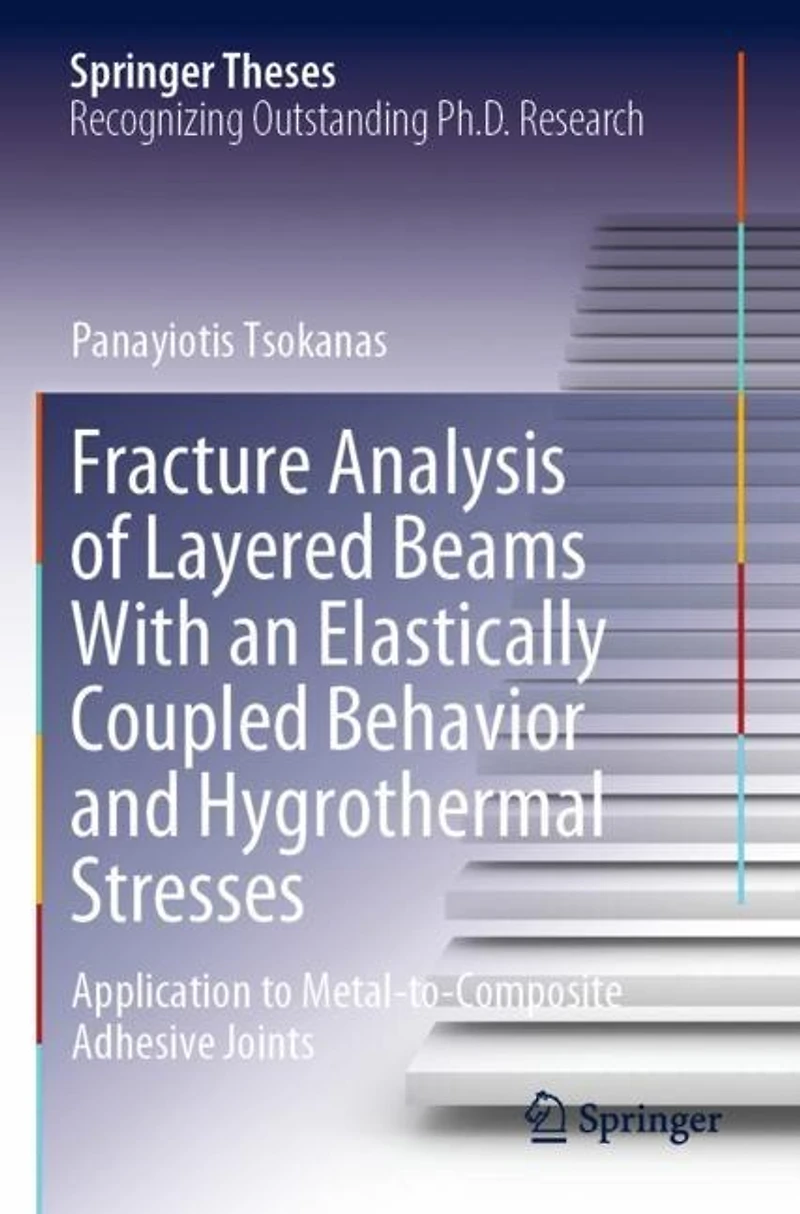
Fracture Analysis of Layered Beams With an Elastically Coupled Behavior and Hygrothermal Stresses: Application to Metal-to-Composite Adhesive Joints in Ottawa, ON
By None
Current price: $364.95

By None
Fracture Analysis of Layered Beams With an Elastically Coupled Behavior and Hygrothermal Stresses: Application to Metal-to-Composite Adhesive Joints in Ottawa, ON
Current price: $364.95
Loading Inventory...
Size: Paperback
*Product information may vary - to confirm product availability, pricing, shipping and return information please contact Coles
This book presents an analytical framework for calculating the fracture toughness of generally layered beam structures with an elastically coupled response and hygrothermal stresses. The beam under study features several peculiarities: it consists of multiple layers of dissimilar materials, features bending-extension coupling, and contains residual hygrothermal stresses. Here, a generic analytical model is proposed to compute the energy release rate and the mode mixity. Mechanics of composite materials, crack closure integral, and energetic methods are among the theoretical tools employed for developing the model. A wealth of new closed-form expressions is presented, together with their validation through finite element analyses, which enables investigating various material systems and testing configurations. Experimentalists will find directions for the design and interpretation of delamination tests on laminated composites with uncommon stacking sequences. At the same time, theoreticians can exploit the analytical solution as a benchmark test for more refined analytical and numerical models. Furthermore, the book gives novel insights into the fracture behavior of a titanium-to-CFRP adhesive joint, which is intended for application in the hybrid laminar flow control of a future aircraft. It reports on experiments and theoretical analyses that help understand the behavior of this novel joint. All in all, this book offers extensive updates on methods for fracture analysis of materials with an elastically coupled behavior and residual stresses. It addresses students, researchers, and engineers alike.
This book presents an analytical framework for calculating the fracture toughness of generally layered beam structures with an elastically coupled response and hygrothermal stresses. The beam under study features several peculiarities: it consists of multiple layers of dissimilar materials, features bending-extension coupling, and contains residual hygrothermal stresses. Here, a generic analytical model is proposed to compute the energy release rate and the mode mixity. Mechanics of composite materials, crack closure integral, and energetic methods are among the theoretical tools employed for developing the model. A wealth of new closed-form expressions is presented, together with their validation through finite element analyses, which enables investigating various material systems and testing configurations. Experimentalists will find directions for the design and interpretation of delamination tests on laminated composites with uncommon stacking sequences. At the same time, theoreticians can exploit the analytical solution as a benchmark test for more refined analytical and numerical models. Furthermore, the book gives novel insights into the fracture behavior of a titanium-to-CFRP adhesive joint, which is intended for application in the hybrid laminar flow control of a future aircraft. It reports on experiments and theoretical analyses that help understand the behavior of this novel joint. All in all, this book offers extensive updates on methods for fracture analysis of materials with an elastically coupled behavior and residual stresses. It addresses students, researchers, and engineers alike.
You May Also Like
















More About Coles at Bayshore Shopping Centre
Coles is renowned for its outstanding customer service and great selection of books. Along with the vast array of magazines, stationary, audio-books, children's literature, fiction, non-fiction and reference books, you can find accessories to make your reading experience more pleasurable. We can recommend the very best in reading today. We will help you search our titles for exactly what you need, and if we do not have it in stock, we will order it for you.
100 Bayshore Dr, Nepean, ON K2B 8C1, Canada
Find Coles at Bayshore Shopping Centre in Ottawa, ON
Visit Coles at Bayshore Shopping Centre in Ottawa, ON