

Give the Gift of Choice!
Too many options? Treat your friends and family to their favourite stores with a Bayshore Shopping Centre gift card, redeemable at participating retailers throughout the centre. Click below to purchase yours today!Purchase HereHome
Globalizing L. A by Steven Erie, Paperback | Indigo Chapters
Coles
Loading Inventory...
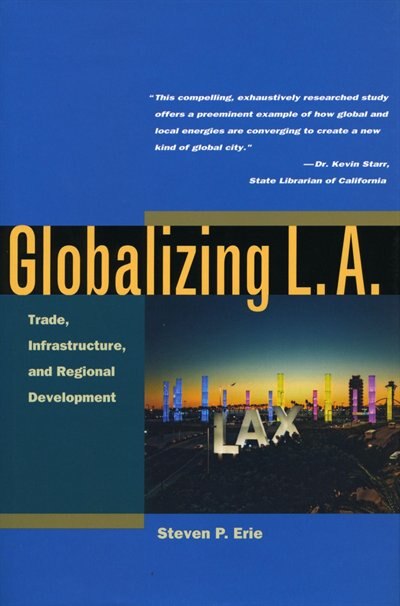
Globalizing L. A by Steven Erie, Paperback | Indigo Chapters in Ottawa, ON
By Steven Erie
Current price: $45.00

By Steven Erie
Globalizing L. A by Steven Erie, Paperback | Indigo Chapters in Ottawa, ON
Current price: $45.00
Loading Inventory...
Size: 1 x 9 x 0.98
*Product information may vary - to confirm product availability, pricing, shipping and return information please contact Coles
How do city-regions successfully compete in the global age? Mixing history and policy analysis, Steven Erie offers a compelling account of the improbable rise of Los Angeles, explaining how a region with no natural harbor and a metropolis situated a distant 20 miles from the coast managed to become the world's ninth largest economy and a leading trade and transportation center. In Globalizing L. A., he argues that physical infrastructure development was a catalytic yet underappreciated factor in the transformation of L. A. and Southern California into a global economy, provocatively challenging the conventional wisdom that emphasizes information flows, intellectual property rights, or social capital. The book also highlights the unheralded role of local political institutions and public entrepreneurs in shaping the region's development, growth, and globalization. Beginning with the fierce battles over railroad and harbor development in the late nineteenth century, Erie chronicles L. A.'s emergence as the nation's leading trade center and gateway to the Pacific Rim in the twentieth century. The book explores recent epic battles over port development, the expansion of LAX, the landmark Alameda Corridor rail link, and implementing NAFTA border-infrastructure projects. Until the 1990s, the book argues, L. A. behaved much like a city-state where powerful, semi-autonomous development bureaucracies and entrepreneurial leaders provided the farsighted strategic planning that made these infrastructure projects possible. Today, Southern California faces daunting challenges, from community and environmental resistance to new post-9/11 security concerns, which will affect its future development and global competitiveness. More Praise for Globalizing L. A.A significant new contribution to the study of urban development. . . . This book will change the way we think about Los Angeles and Southern California. . . . It is the next great book on the region.-David Perry, Director and Professor, Great Cities Institute University of Illinois at Chicago | Globalizing L. A by Steven Erie, Paperback | Indigo Chapters
How do city-regions successfully compete in the global age? Mixing history and policy analysis, Steven Erie offers a compelling account of the improbable rise of Los Angeles, explaining how a region with no natural harbor and a metropolis situated a distant 20 miles from the coast managed to become the world's ninth largest economy and a leading trade and transportation center. In Globalizing L. A., he argues that physical infrastructure development was a catalytic yet underappreciated factor in the transformation of L. A. and Southern California into a global economy, provocatively challenging the conventional wisdom that emphasizes information flows, intellectual property rights, or social capital. The book also highlights the unheralded role of local political institutions and public entrepreneurs in shaping the region's development, growth, and globalization. Beginning with the fierce battles over railroad and harbor development in the late nineteenth century, Erie chronicles L. A.'s emergence as the nation's leading trade center and gateway to the Pacific Rim in the twentieth century. The book explores recent epic battles over port development, the expansion of LAX, the landmark Alameda Corridor rail link, and implementing NAFTA border-infrastructure projects. Until the 1990s, the book argues, L. A. behaved much like a city-state where powerful, semi-autonomous development bureaucracies and entrepreneurial leaders provided the farsighted strategic planning that made these infrastructure projects possible. Today, Southern California faces daunting challenges, from community and environmental resistance to new post-9/11 security concerns, which will affect its future development and global competitiveness. More Praise for Globalizing L. A.A significant new contribution to the study of urban development. . . . This book will change the way we think about Los Angeles and Southern California. . . . It is the next great book on the region.-David Perry, Director and Professor, Great Cities Institute University of Illinois at Chicago | Globalizing L. A by Steven Erie, Paperback | Indigo Chapters
You May Also Like










More About Coles at Bayshore Shopping Centre
Coles is renowned for its outstanding customer service and great selection of books. Along with the vast array of magazines, stationary, audio-books, children's literature, fiction, non-fiction and reference books, you can find accessories to make your reading experience more pleasurable. We can recommend the very best in reading today. We will help you search our titles for exactly what you need, and if we do not have it in stock, we will order it for you.
100 Bayshore Dr, Nepean, ON K2B 8C1, Canada
Find Coles at Bayshore Shopping Centre in Ottawa, ON
Visit Coles at Bayshore Shopping Centre in Ottawa, ON