

Give the Gift of Choice!
Too many options? Treat your friends and family to their favourite stores with a Bayshore Shopping Centre gift card, redeemable at participating retailers throughout the centre. Click below to purchase yours today!Purchase HereHome
Grammatical gender and its impact on the categorization of inanimate objects
Coles
Loading Inventory...
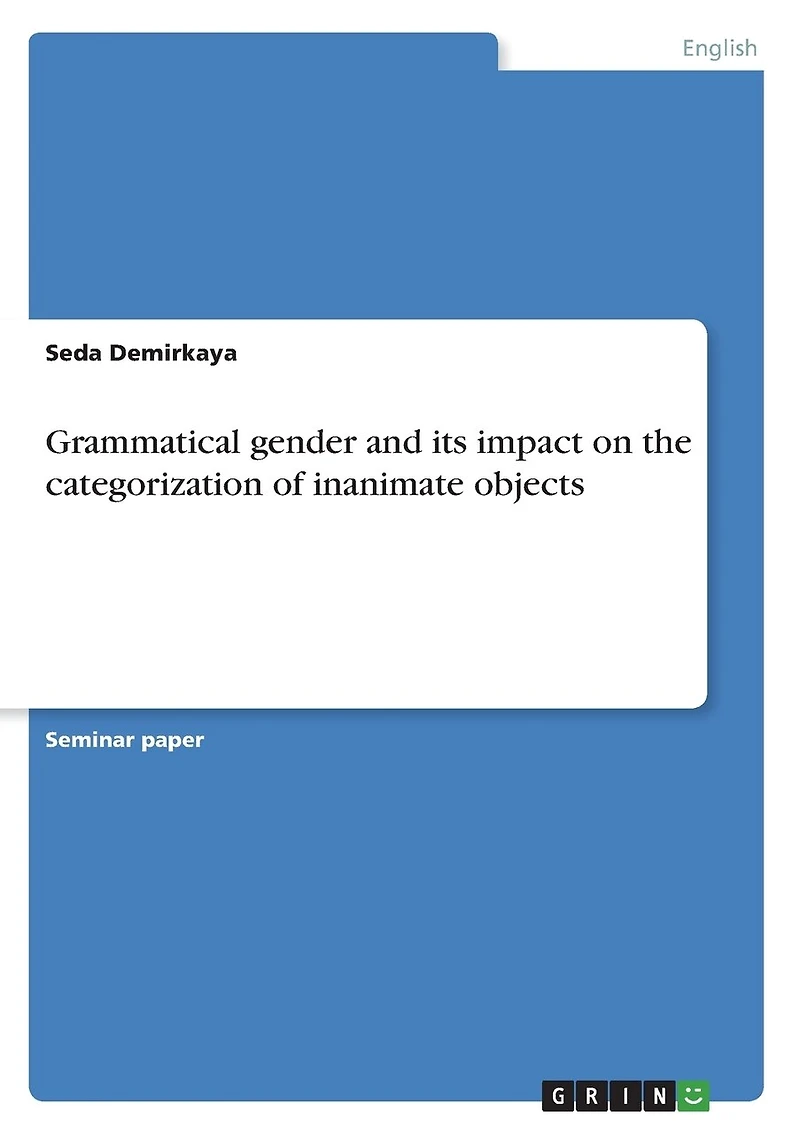
Grammatical gender and its impact on the categorization of inanimate objects in Ottawa, ON
Current price: $29.50

Grammatical gender and its impact on the categorization of inanimate objects in Ottawa, ON
Current price: $29.50
Loading Inventory...
Size: Paperback
*Product information may vary - to confirm product availability, pricing, shipping and return information please contact Coles
Seminar paper from the year 2019 in the subject English Language and Literature Studies - Other, grade: 1,3, University of Wuppertal, language: English, abstract: Throughout history, the relation between language and thought has been of interest for scholars of different fields such as philosophy, psychology and linguistics. Whereas Wittgenstein was convinced that language is thought, as "[n]ow it is becoming clear why [he] thought that thinking and language were the same. For thinking is a kind of language," (1969) others like Pinker (1994) and Fodor (1975) believed there is no relation whatsoever and that thought is independent of language. However, with regard to studies confirming the notion of language indeed having an effect on cognition, the broad consensus is that neither of these extreme approaches is correct and that the truth is situated somewhere in between. In this context, it is the Sapir-Whorf (or Whorfian) hypothesis-better known as the linguistic relativity hypothesis-that has gained great attention amongst psycholinguists, for at its heart it holds the very idea that the languages we speak at least influence the way we think. Evidence supporting this theory stems from various domains describing differences between languages with respect to perceptions and judgments of concepts, such as quantity, space and time. In recent decades, however, the grammatical gender of nouns in particular, as one aspect of grammar, has been the focus of investigations and debates on linguistic relativity. Several cross-linguistic studies indicate that speakers of languages which have a gender system tend to assign stereotypical attributes and properties to inanimate objects congruent with their grammatical gender. Though there is empirical evidence substantiating this hypothesis, there is a considerable amount of research findings which show little to no support, which therefore leads to the question whether grammatical gender is a useful tool for the investigation
Seminar paper from the year 2019 in the subject English Language and Literature Studies - Other, grade: 1,3, University of Wuppertal, language: English, abstract: Throughout history, the relation between language and thought has been of interest for scholars of different fields such as philosophy, psychology and linguistics. Whereas Wittgenstein was convinced that language is thought, as "[n]ow it is becoming clear why [he] thought that thinking and language were the same. For thinking is a kind of language," (1969) others like Pinker (1994) and Fodor (1975) believed there is no relation whatsoever and that thought is independent of language. However, with regard to studies confirming the notion of language indeed having an effect on cognition, the broad consensus is that neither of these extreme approaches is correct and that the truth is situated somewhere in between. In this context, it is the Sapir-Whorf (or Whorfian) hypothesis-better known as the linguistic relativity hypothesis-that has gained great attention amongst psycholinguists, for at its heart it holds the very idea that the languages we speak at least influence the way we think. Evidence supporting this theory stems from various domains describing differences between languages with respect to perceptions and judgments of concepts, such as quantity, space and time. In recent decades, however, the grammatical gender of nouns in particular, as one aspect of grammar, has been the focus of investigations and debates on linguistic relativity. Several cross-linguistic studies indicate that speakers of languages which have a gender system tend to assign stereotypical attributes and properties to inanimate objects congruent with their grammatical gender. Though there is empirical evidence substantiating this hypothesis, there is a considerable amount of research findings which show little to no support, which therefore leads to the question whether grammatical gender is a useful tool for the investigation
You May Also Like


















More About Coles at Bayshore Shopping Centre
Coles is renowned for its outstanding customer service and great selection of books. Along with the vast array of magazines, stationary, audio-books, children's literature, fiction, non-fiction and reference books, you can find accessories to make your reading experience more pleasurable. We can recommend the very best in reading today. We will help you search our titles for exactly what you need, and if we do not have it in stock, we will order it for you.
100 Bayshore Dr, Nepean, ON K2B 8C1, Canada
Find Coles at Bayshore Shopping Centre in Ottawa, ON
Visit Coles at Bayshore Shopping Centre in Ottawa, ON