

Give the Gift of Choice!
Too many options? Treat your friends and family to their favourite stores with a Bayshore Shopping Centre gift card, redeemable at participating retailers throughout the centre. Click below to purchase yours today!Purchase HereHome
Heredity of Hair-Length in Guinea-Pigs and Its Bearing on the Theory of Pure Gametes, And, the Origin of a Polydactylous Race of Guinea-Pigs (Classic Reprint)
Coles
Loading Inventory...
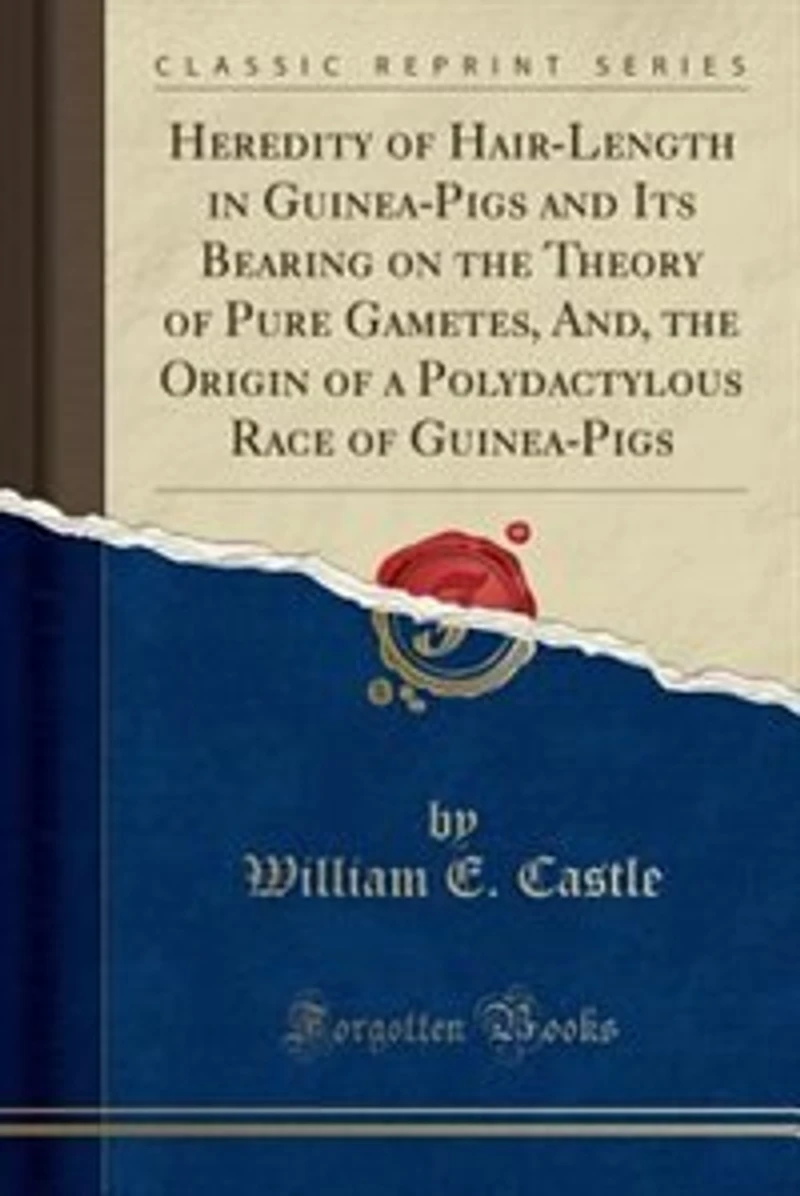
Heredity of Hair-Length in Guinea-Pigs and Its Bearing on the Theory of Pure Gametes, And, the Origin of a Polydactylous Race of Guinea-Pigs (Classic Reprint) in Ottawa, ON
Current price: $7.97

Heredity of Hair-Length in Guinea-Pigs and Its Bearing on the Theory of Pure Gametes, And, the Origin of a Polydactylous Race of Guinea-Pigs (Classic Reprint) in Ottawa, ON
Current price: $7.97
Loading Inventory...
Size: Paperback
*Product information may vary - to confirm product availability, pricing, shipping and return information please contact Coles
Excerpt from Heredity of Hair-Length in Guinea-Pigs and Its Bearing on the Theory of Pure Gametes, And, the Origin of a Polydactylous Race of Guinea-Pigs A litter of four guinea - pigs of a pure short-haired race yielded measure ments which combined are expressed graphically in Fig. 2, A. Starting at birth with a length of about 18 mm., the hairs grew very rapidly during the first week, at the end of which they measured about 25 mm., an average increase of a millimeter a day in the second and third weeks they grew less rapidly, measuring about 29 mm. At the end of two weeks, and 33 mm. At the end of three weeks. At this time the growth of the hairs which the animals bore at birth was practically complete; the hair-follicles now ceased to form medullary substance, and consequently the hair narrowed to a base of solid cortex (fig. I). From this time on the measurements Show from week to week only slight deviations from a length of 3 3 to 3 5 mm. Several series of measurements of the hair of long-haired guinea-pigs, when combined and expressed graphically, are shown in D, Fig. 2. The hair-length at birth is about the same as in animals of class A, or even a little shorter, but the growth rate does not show the series of rapid changes seen in class A. Growth progresses very steadily at an average rate of about min. A day during the first one hundred days and at about mm. A day during the second one hundred days. But a glance at Fig. 2, D, shows that the slowing up of the growth rate is a very gradual process. About the Publisher Forgotten Books publishes hundreds of thousands of rare and classic books. Find more at www.forgottenbooks.com This book is a reproduction of an important historical work. Forgotten Books uses state-of-the-art technology to digitally reconstruct the work, preserving the original format whilst repairing imperfections present in the aged copy. In rare cases, an imperfection in the original, such as a blemish or missing page, may be replicated in our edition. We do, however, repair the vast majority of imperfections successfully; any imperfections that remain are intentionally left to preserve the state of such historical works.
Excerpt from Heredity of Hair-Length in Guinea-Pigs and Its Bearing on the Theory of Pure Gametes, And, the Origin of a Polydactylous Race of Guinea-Pigs A litter of four guinea - pigs of a pure short-haired race yielded measure ments which combined are expressed graphically in Fig. 2, A. Starting at birth with a length of about 18 mm., the hairs grew very rapidly during the first week, at the end of which they measured about 25 mm., an average increase of a millimeter a day in the second and third weeks they grew less rapidly, measuring about 29 mm. At the end of two weeks, and 33 mm. At the end of three weeks. At this time the growth of the hairs which the animals bore at birth was practically complete; the hair-follicles now ceased to form medullary substance, and consequently the hair narrowed to a base of solid cortex (fig. I). From this time on the measurements Show from week to week only slight deviations from a length of 3 3 to 3 5 mm. Several series of measurements of the hair of long-haired guinea-pigs, when combined and expressed graphically, are shown in D, Fig. 2. The hair-length at birth is about the same as in animals of class A, or even a little shorter, but the growth rate does not show the series of rapid changes seen in class A. Growth progresses very steadily at an average rate of about min. A day during the first one hundred days and at about mm. A day during the second one hundred days. But a glance at Fig. 2, D, shows that the slowing up of the growth rate is a very gradual process. About the Publisher Forgotten Books publishes hundreds of thousands of rare and classic books. Find more at www.forgottenbooks.com This book is a reproduction of an important historical work. Forgotten Books uses state-of-the-art technology to digitally reconstruct the work, preserving the original format whilst repairing imperfections present in the aged copy. In rare cases, an imperfection in the original, such as a blemish or missing page, may be replicated in our edition. We do, however, repair the vast majority of imperfections successfully; any imperfections that remain are intentionally left to preserve the state of such historical works.
You May Also Like

















More About Coles at Bayshore Shopping Centre
Coles is renowned for its outstanding customer service and great selection of books. Along with the vast array of magazines, stationary, audio-books, children's literature, fiction, non-fiction and reference books, you can find accessories to make your reading experience more pleasurable. We can recommend the very best in reading today. We will help you search our titles for exactly what you need, and if we do not have it in stock, we will order it for you.
100 Bayshore Dr, Nepean, ON K2B 8C1, Canada
Find Coles at Bayshore Shopping Centre in Ottawa, ON
Visit Coles at Bayshore Shopping Centre in Ottawa, ON