

Give the Gift of Choice!
Too many options? Treat your friends and family to their favourite stores with a Bayshore Shopping Centre gift card, redeemable at participating retailers throughout the centre. Click below to purchase yours today!Purchase HereHome
Hypermedia Genes: An Evolutionary Perspective on Concepts, Models, and Architectures
Coles
Loading Inventory...
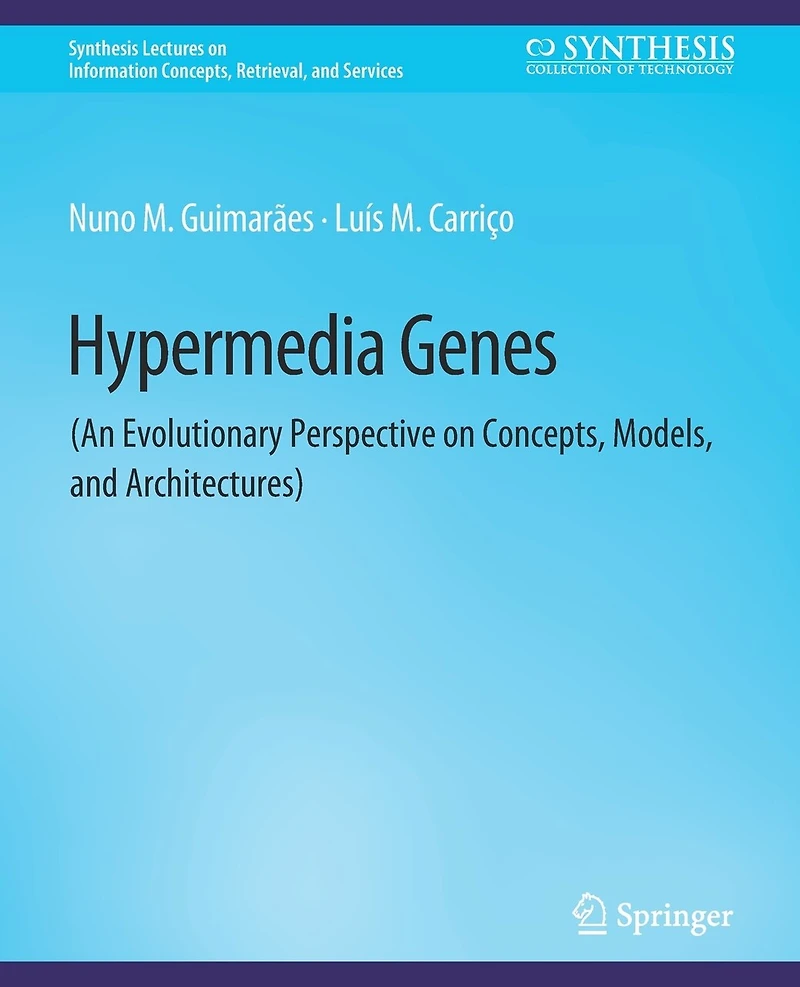
Hypermedia Genes: An Evolutionary Perspective on Concepts, Models, and Architectures in Ottawa, ON
Current price: $36.50

Hypermedia Genes: An Evolutionary Perspective on Concepts, Models, and Architectures in Ottawa, ON
Current price: $36.50
Loading Inventory...
Size: Paperback
*Product information may vary - to confirm product availability, pricing, shipping and return information please contact Coles
The design space of information services evolved from seminal works through a set of prototypical hypermedia systems and matured in open and widely accessible web-based systems. The original concepts of hypermedia systems are now expressed in different forms and shapes. The first works on hypertext invented the term itself, laid out the foundational concept of association or link, and highlighted navigation as the core paradigm for the future information systems. The first engineered systems demonstrated architectural requirements and models and fostered the emergence of the conceptual model related with the information systems and the information design. The artifacts for interaction, navigation, and search, grew from the pioneering systems. Multimedia added a new dimension to hypertext, and mutated the term into hypermedia. The adaptation of the primitive models and mechanisms to the space of continuous media led to a further conceptual level and to the reinvention of information design methods. Hypermedia systems also became an ideal space for collaboration and cooperative work. Information access and sharing, and group work were enabled and empowered by distributed hypermedia systems. As with many technologies, a winning technical paradigm, in our case the World Wide Web, concentrated the design options, the architectural choices and the interaction and navigation styles. Since the late nineties, the Web became the standard framework for hypermedia systems, and integrated a large number of the initial concepts and techniques. Yet, other paths are still open. This lecture maps a simple "genome" of hypermedia systems, based on an initial survey of primitive systems that established architectural and functional characteristics, or traits. These are analyzed and consolidated using phylogenetic analysis tools, to infer families of systems and evolution opportunities. This method may prove to be inspiring for more systematic perspectives of technological landscapes. Table of Contents: Introduction / Original Visions and Concepts / Steps in the Evolution / Information and Structured Documents / Web-Based Environments / Some Research Trends / A Framework of Traits / A Phylogenetic Analysis / Conclusion
The design space of information services evolved from seminal works through a set of prototypical hypermedia systems and matured in open and widely accessible web-based systems. The original concepts of hypermedia systems are now expressed in different forms and shapes. The first works on hypertext invented the term itself, laid out the foundational concept of association or link, and highlighted navigation as the core paradigm for the future information systems. The first engineered systems demonstrated architectural requirements and models and fostered the emergence of the conceptual model related with the information systems and the information design. The artifacts for interaction, navigation, and search, grew from the pioneering systems. Multimedia added a new dimension to hypertext, and mutated the term into hypermedia. The adaptation of the primitive models and mechanisms to the space of continuous media led to a further conceptual level and to the reinvention of information design methods. Hypermedia systems also became an ideal space for collaboration and cooperative work. Information access and sharing, and group work were enabled and empowered by distributed hypermedia systems. As with many technologies, a winning technical paradigm, in our case the World Wide Web, concentrated the design options, the architectural choices and the interaction and navigation styles. Since the late nineties, the Web became the standard framework for hypermedia systems, and integrated a large number of the initial concepts and techniques. Yet, other paths are still open. This lecture maps a simple "genome" of hypermedia systems, based on an initial survey of primitive systems that established architectural and functional characteristics, or traits. These are analyzed and consolidated using phylogenetic analysis tools, to infer families of systems and evolution opportunities. This method may prove to be inspiring for more systematic perspectives of technological landscapes. Table of Contents: Introduction / Original Visions and Concepts / Steps in the Evolution / Information and Structured Documents / Web-Based Environments / Some Research Trends / A Framework of Traits / A Phylogenetic Analysis / Conclusion
You May Also Like














More About Coles at Bayshore Shopping Centre
Coles is renowned for its outstanding customer service and great selection of books. Along with the vast array of magazines, stationary, audio-books, children's literature, fiction, non-fiction and reference books, you can find accessories to make your reading experience more pleasurable. We can recommend the very best in reading today. We will help you search our titles for exactly what you need, and if we do not have it in stock, we will order it for you.
100 Bayshore Dr, Nepean, ON K2B 8C1, Canada
Find Coles at Bayshore Shopping Centre in Ottawa, ON
Visit Coles at Bayshore Shopping Centre in Ottawa, ON