

Give the Gift of Choice!
Too many options? Treat your friends and family to their favourite stores with a Bayshore Shopping Centre gift card, redeemable at participating retailers throughout the centre. Click below to purchase yours today!Purchase HereHome
Information Theory Tools for Computer Graphics
Coles
Loading Inventory...
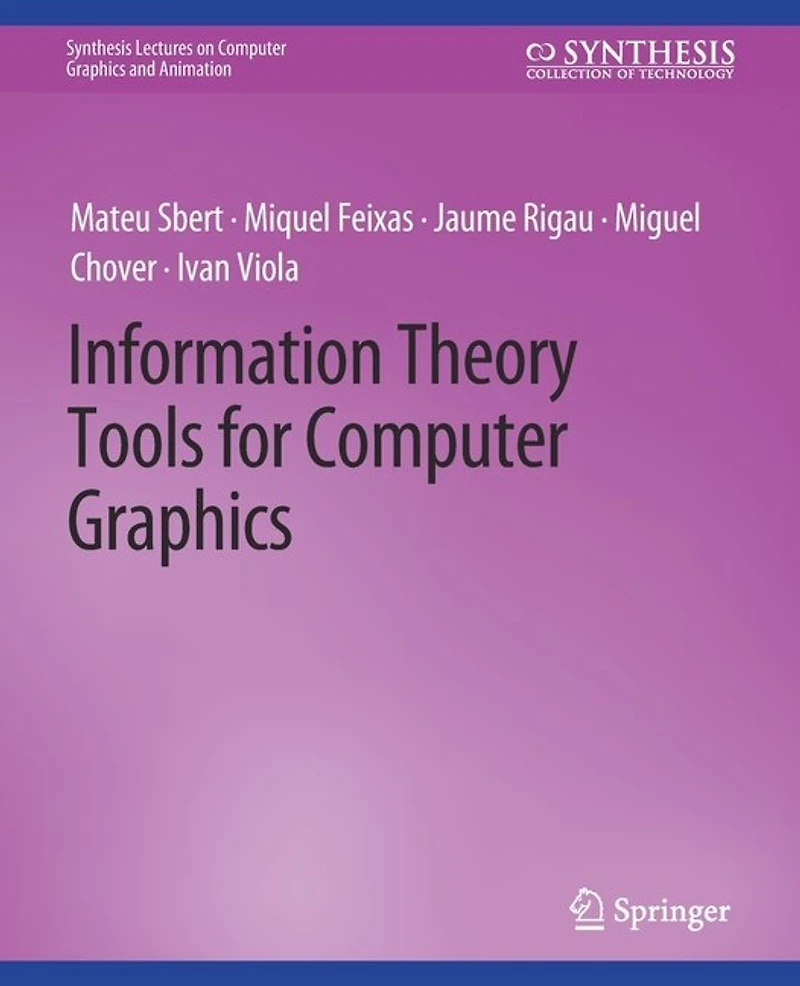
Information Theory Tools for Computer Graphics in Ottawa, ON
Current price: $49.50

Information Theory Tools for Computer Graphics in Ottawa, ON
Current price: $49.50
Loading Inventory...
Size: Paperback
*Product information may vary - to confirm product availability, pricing, shipping and return information please contact Coles
Information theory (IT) tools, widely used in scientific fields such as engineering, physics, genetics, neuroscience, and many others, are also emerging as useful transversal tools in computer graphics. In this book, we present the basic concepts of IT and how they have been applied to the graphics areas of radiosity, adaptive ray-tracing, shape descriptors, viewpoint selection and saliency, scientific visualization, and geometry simplification. Some of the approaches presented, such as the viewpoint techniques, are now the state of the art in visualization. Almost all of the techniques presented in this book have been previously published in peer-reviewed conference proceedings or international journals. Here, we have stressed their common aspects and presented them in an unified way, so the reader can clearly see which problems IT tools can help solve, which specific tools to use, and how to apply them. A basic level of knowledge in computer graphics is required but basic concepts inIT are presented. The intended audiences are both students and practitioners of the fields above and related areas in computer graphics. In addition, IT practitioners will learn about these applications. Table of Contents: Information Theory Basics / Scene Complexity and Refinement Criteria for Radiosity / Shape Descriptors / Refinement Criteria for Ray-Tracing / Viewpoint Selection and Mesh Saliency / View Selection in Scientific Visualization / Viewpoint-based Geometry Simplification
Information theory (IT) tools, widely used in scientific fields such as engineering, physics, genetics, neuroscience, and many others, are also emerging as useful transversal tools in computer graphics. In this book, we present the basic concepts of IT and how they have been applied to the graphics areas of radiosity, adaptive ray-tracing, shape descriptors, viewpoint selection and saliency, scientific visualization, and geometry simplification. Some of the approaches presented, such as the viewpoint techniques, are now the state of the art in visualization. Almost all of the techniques presented in this book have been previously published in peer-reviewed conference proceedings or international journals. Here, we have stressed their common aspects and presented them in an unified way, so the reader can clearly see which problems IT tools can help solve, which specific tools to use, and how to apply them. A basic level of knowledge in computer graphics is required but basic concepts inIT are presented. The intended audiences are both students and practitioners of the fields above and related areas in computer graphics. In addition, IT practitioners will learn about these applications. Table of Contents: Information Theory Basics / Scene Complexity and Refinement Criteria for Radiosity / Shape Descriptors / Refinement Criteria for Ray-Tracing / Viewpoint Selection and Mesh Saliency / View Selection in Scientific Visualization / Viewpoint-based Geometry Simplification
You May Also Like











More About Coles at Bayshore Shopping Centre
Coles is renowned for its outstanding customer service and great selection of books. Along with the vast array of magazines, stationary, audio-books, children's literature, fiction, non-fiction and reference books, you can find accessories to make your reading experience more pleasurable. We can recommend the very best in reading today. We will help you search our titles for exactly what you need, and if we do not have it in stock, we will order it for you.
100 Bayshore Dr, Nepean, ON K2B 8C1, Canada
Find Coles at Bayshore Shopping Centre in Ottawa, ON
Visit Coles at Bayshore Shopping Centre in Ottawa, ON