

Give the Gift of Choice!
Too many options? Treat your friends and family to their favourite stores with a Bayshore Shopping Centre gift card, redeemable at participating retailers throughout the centre. Click below to purchase yours today!Purchase HereHome
Mathematical Methods for Oscillations and Waves
Coles
Loading Inventory...
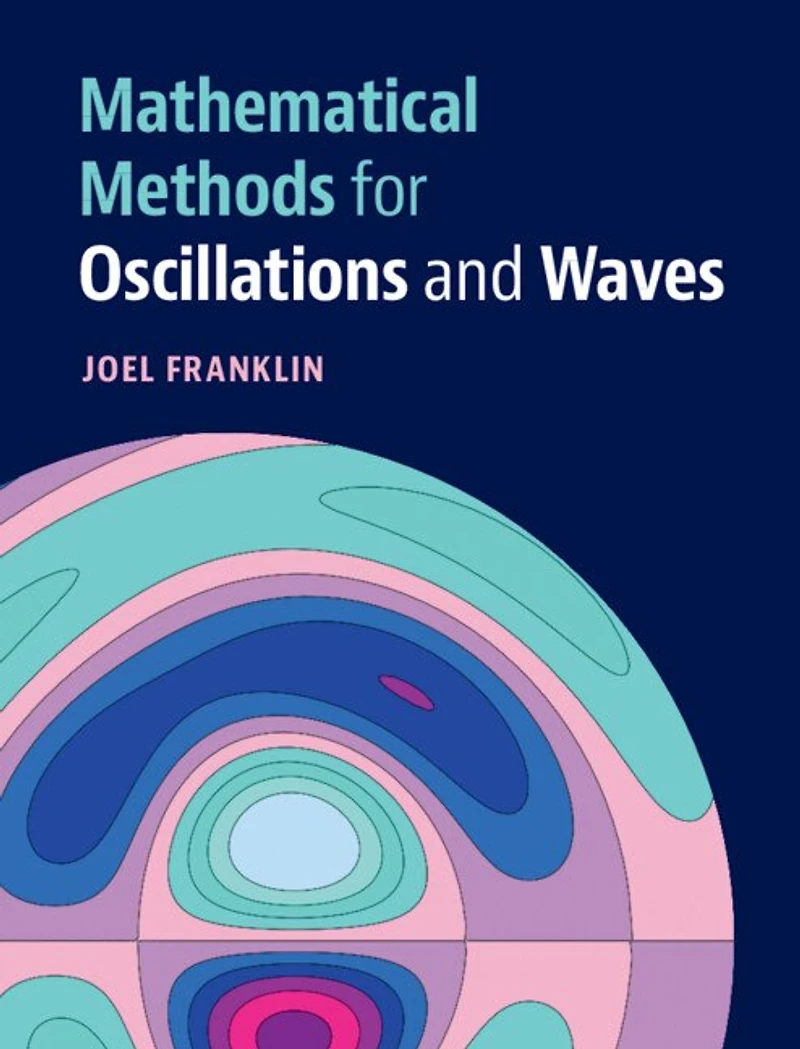
Mathematical Methods for Oscillations and Waves in Ottawa, ON
Current price: $91.95

Mathematical Methods for Oscillations and Waves in Ottawa, ON
Current price: $91.95
Loading Inventory...
Size: Hardcover
*Product information may vary - to confirm product availability, pricing, shipping and return information please contact Coles
Anchored in simple and familiar physics problems, the author provides a focused introduction to mathematical methods in a narrative driven and structured manner. Ordinary and partial differential equation solving, linear algebra, vector calculus, complex variables and numerical methods are all introduced and bear relevance to a wide range of physical problems. Expanded and novel applications of these methods highlight their utility in less familiar areas, and advertise those areas that will become more important as students continue. This highlights both the utility of each method in progressing with problems of increasing complexity while also allowing students to see how a simplified problem becomes 're-complexified'. Advanced topics include nonlinear partial differential equations, and relativistic and quantum mechanical variants of problems like the harmonic oscillator. Physics, mathematics and engineering students will find 300 problems treated in a sophisticated manner. The insights emerging from Franklin's treatment make it a valuable teaching resource.
Anchored in simple and familiar physics problems, the author provides a focused introduction to mathematical methods in a narrative driven and structured manner. Ordinary and partial differential equation solving, linear algebra, vector calculus, complex variables and numerical methods are all introduced and bear relevance to a wide range of physical problems. Expanded and novel applications of these methods highlight their utility in less familiar areas, and advertise those areas that will become more important as students continue. This highlights both the utility of each method in progressing with problems of increasing complexity while also allowing students to see how a simplified problem becomes 're-complexified'. Advanced topics include nonlinear partial differential equations, and relativistic and quantum mechanical variants of problems like the harmonic oscillator. Physics, mathematics and engineering students will find 300 problems treated in a sophisticated manner. The insights emerging from Franklin's treatment make it a valuable teaching resource.
You May Also Like







More About Coles at Bayshore Shopping Centre
Coles is renowned for its outstanding customer service and great selection of books. Along with the vast array of magazines, stationary, audio-books, children's literature, fiction, non-fiction and reference books, you can find accessories to make your reading experience more pleasurable. We can recommend the very best in reading today. We will help you search our titles for exactly what you need, and if we do not have it in stock, we will order it for you.
100 Bayshore Dr, Nepean, ON K2B 8C1, Canada
Find Coles at Bayshore Shopping Centre in Ottawa, ON
Visit Coles at Bayshore Shopping Centre in Ottawa, ON