

Give the Gift of Choice!
Too many options? Treat your friends and family to their favourite stores with a Bayshore Shopping Centre gift card, redeemable at participating retailers throughout the centre. Click below to purchase yours today!Purchase HereHome
Numerical Calculation for Physics Laboratory Projects Using Microsoft EXCEL(R)
Coles
Loading Inventory...
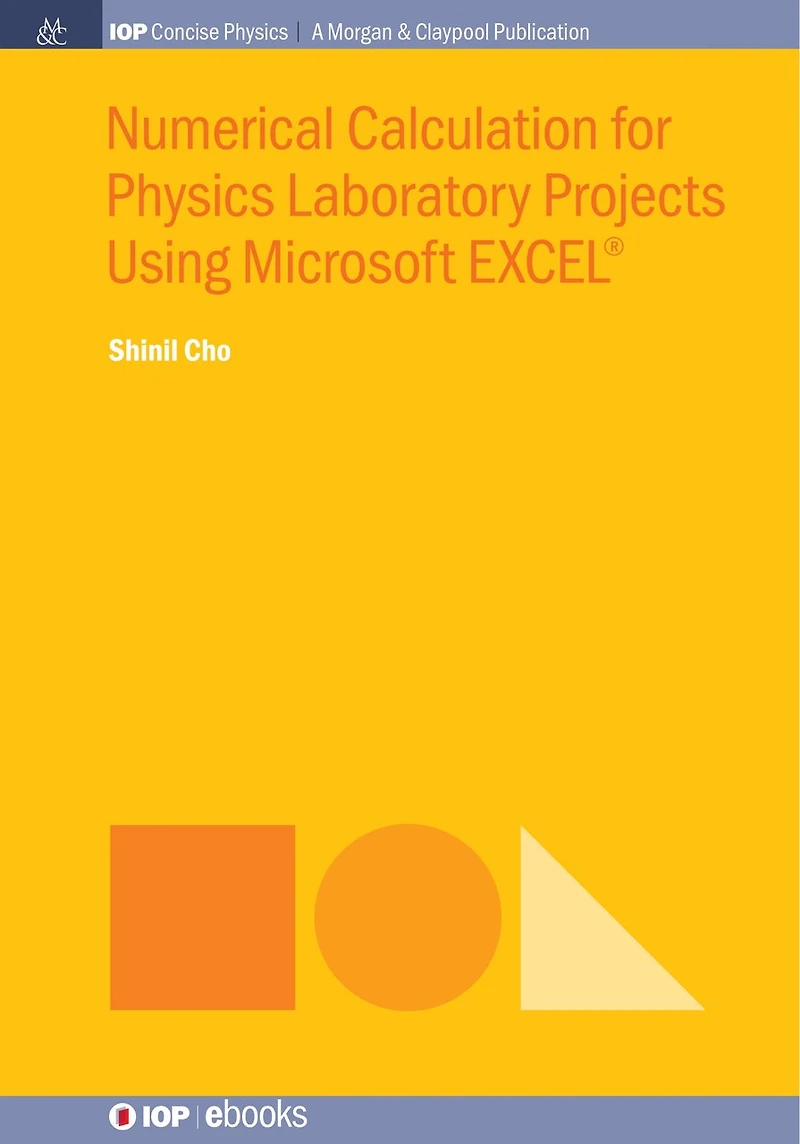
Numerical Calculation for Physics Laboratory Projects Using Microsoft EXCEL(R) in Ottawa, ON
Current price: $110.95

Numerical Calculation for Physics Laboratory Projects Using Microsoft EXCEL(R) in Ottawa, ON
Current price: $110.95
Loading Inventory...
Size: Hardcover
*Product information may vary - to confirm product availability, pricing, shipping and return information please contact Coles
This book covers essential Microsoft EXCEL(R)'s computational skills while analyzing introductory physics projects. Topics of numerical analysis include; multiple graphs on the same sheet, calculation of descriptive statistical parameters, a 3-point interpolation, the Euler and the Runge-Kutter methods to solve equations of motion, the Fourier transform to calculate the normal modes of a double pendulum, matrix calculations to solve coupled linear equations of a DC circuit, animation of waves and Lissajous figures, electric and magnetic field calculations from the Poisson equation and its 3D surface graphs, variational calculus such as Fermat's least traveling time principle and the least action principle. Nelson's stochastic quantum dynamics is also introduced to draw quantum particle trajectories.
This book covers essential Microsoft EXCEL(R)'s computational skills while analyzing introductory physics projects. Topics of numerical analysis include; multiple graphs on the same sheet, calculation of descriptive statistical parameters, a 3-point interpolation, the Euler and the Runge-Kutter methods to solve equations of motion, the Fourier transform to calculate the normal modes of a double pendulum, matrix calculations to solve coupled linear equations of a DC circuit, animation of waves and Lissajous figures, electric and magnetic field calculations from the Poisson equation and its 3D surface graphs, variational calculus such as Fermat's least traveling time principle and the least action principle. Nelson's stochastic quantum dynamics is also introduced to draw quantum particle trajectories.
You May Also Like
















More About Coles at Bayshore Shopping Centre
Coles is renowned for its outstanding customer service and great selection of books. Along with the vast array of magazines, stationary, audio-books, children's literature, fiction, non-fiction and reference books, you can find accessories to make your reading experience more pleasurable. We can recommend the very best in reading today. We will help you search our titles for exactly what you need, and if we do not have it in stock, we will order it for you.
100 Bayshore Dr, Nepean, ON K2B 8C1, Canada
Find Coles at Bayshore Shopping Centre in Ottawa, ON
Visit Coles at Bayshore Shopping Centre in Ottawa, ON