

Give the Gift of Choice!
Too many options? Treat your friends and family to their favourite stores with a Bayshore Shopping Centre gift card, redeemable at participating retailers throughout the centre. Click below to purchase yours today!Purchase HereHome
Prime-detecting Sieves (lms-33) by Glyn Harman, Paperback | Indigo Chapters
Coles
Loading Inventory...
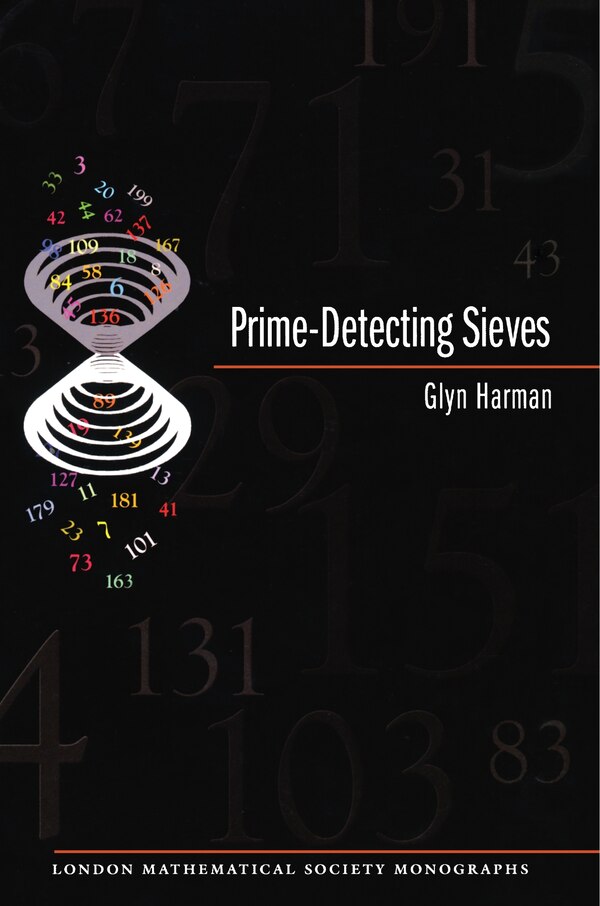
Prime-detecting Sieves (lms-33) by Glyn Harman, Paperback | Indigo Chapters in Ottawa, ON
By Glyn Harman
Current price: $126.00

By Glyn Harman
Prime-detecting Sieves (lms-33) by Glyn Harman, Paperback | Indigo Chapters in Ottawa, ON
Current price: $126.00
Loading Inventory...
Size: 25.4 x 234.95 x 1
*Product information may vary - to confirm product availability, pricing, shipping and return information please contact Coles
This book seeks to describe the rapid development in recent decades of sieve methods able to detect prime numbers. The subject began with Eratosthenes in antiquity, took on new shape with Legendre's form of the sieve, was substantially reworked by Ivan M. Vinogradov and Yuri V. Linnik, but came into its own with Robert C. Vaughan and important contributions from others, notably Roger Heath-Brown and Henryk Iwaniec. Prime-Detecting Sieves breaks new ground by bringing together several different types of problems that have been tackled with modern sieve methods and by discussing the ideas common to each, in particular the use of Type I and Type II information. No other book has undertaken such a systematic treatment of prime-detecting sieves. Among the many topics Glyn Harman covers are primes in short intervals, the greatest prime factor of the sequence of shifted primes, Goldbach numbers in short intervals, the distribution of Gaussian primes, and the recent work of John Friedlander and Iwaniec on primes that are a sum of a square and a fourth power, and Heath-Brown's work on primes represented as a cube plus twice a cube. This book contains much that is accessible to beginning graduate students, yet also provides insights that will benefit established researchers. | Prime-detecting Sieves (lms-33) by Glyn Harman, Paperback | Indigo Chapters
This book seeks to describe the rapid development in recent decades of sieve methods able to detect prime numbers. The subject began with Eratosthenes in antiquity, took on new shape with Legendre's form of the sieve, was substantially reworked by Ivan M. Vinogradov and Yuri V. Linnik, but came into its own with Robert C. Vaughan and important contributions from others, notably Roger Heath-Brown and Henryk Iwaniec. Prime-Detecting Sieves breaks new ground by bringing together several different types of problems that have been tackled with modern sieve methods and by discussing the ideas common to each, in particular the use of Type I and Type II information. No other book has undertaken such a systematic treatment of prime-detecting sieves. Among the many topics Glyn Harman covers are primes in short intervals, the greatest prime factor of the sequence of shifted primes, Goldbach numbers in short intervals, the distribution of Gaussian primes, and the recent work of John Friedlander and Iwaniec on primes that are a sum of a square and a fourth power, and Heath-Brown's work on primes represented as a cube plus twice a cube. This book contains much that is accessible to beginning graduate students, yet also provides insights that will benefit established researchers. | Prime-detecting Sieves (lms-33) by Glyn Harman, Paperback | Indigo Chapters
You May Also Like
















More About Coles at Bayshore Shopping Centre
Coles is renowned for its outstanding customer service and great selection of books. Along with the vast array of magazines, stationary, audio-books, children's literature, fiction, non-fiction and reference books, you can find accessories to make your reading experience more pleasurable. We can recommend the very best in reading today. We will help you search our titles for exactly what you need, and if we do not have it in stock, we will order it for you.
100 Bayshore Dr, Nepean, ON K2B 8C1, Canada
Find Coles at Bayshore Shopping Centre in Ottawa, ON
Visit Coles at Bayshore Shopping Centre in Ottawa, ON