

Give the Gift of Choice!
Too many options? Treat your friends and family to their favourite stores with a Bayshore Shopping Centre gift card, redeemable at participating retailers throughout the centre. Click below to purchase yours today!Purchase HereHome
PSpice for Digital Signal Processing
Coles
Loading Inventory...
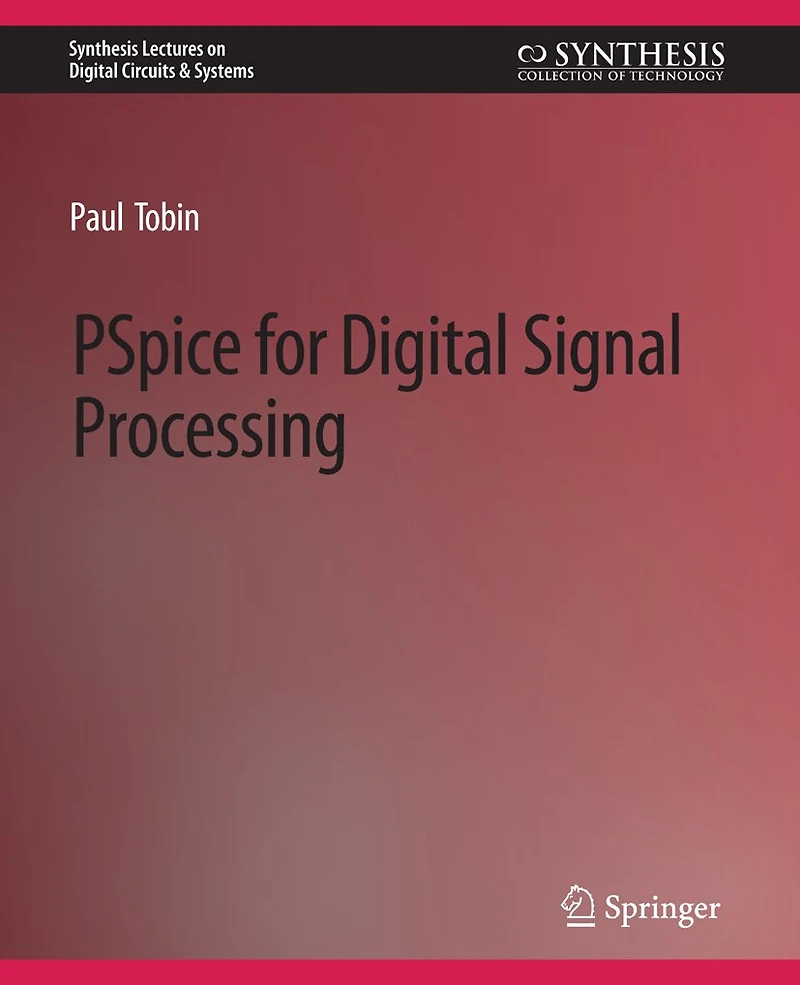
PSpice for Digital Signal Processing in Ottawa, ON
Current price: $58.50

PSpice for Digital Signal Processing in Ottawa, ON
Current price: $58.50
Loading Inventory...
Size: Paperback
*Product information may vary - to confirm product availability, pricing, shipping and return information please contact Coles
PSpice for Digital Signal Processing is the last in a series of five books using Cadence Orcad PSpice version 10.5 and introduces a very novel approach to learning digital signal processing (DSP). DSP is traditionally taught using Matlab/Simulink software but has some inherent weaknesses for students particularly at the introductory level. The 'plug in variables and play' nature of these software packages can lure the student into thinking they possess an understanding they don't actually have because these systems produce results quicklywithout revealing what is going on. However, it must be said that, for advanced level work Matlab/Simulink really excel. In this book we start by examining basic signals starting with sampled signals and dealing with the concept of digital frequency. The delay part, which is the heart of DSP, is explained and applied initially to simple FIR and IIR filters. We examine linear time invariant systems starting with the difference equation and applying thez-transform to produce a range of filter type i.e. low-pass, high-pass and bandpass. The important concept of convolution is examined and here we demonstrate the usefulness of the 'log' command in Probe for giving the correct display to demonstrate the 'flip n slip' method. Digital oscillators, including quadrature carrier generation, are then examined. Several filter design methods are considered and include the bilinear transform, impulse invariant, and window techniques. Included also is a treatment of the raised-cosine family of filters. A range of DSP applications are then considered and include the Hilbert transform, single sideband modulator using the Hilbert transform and quad oscillators, integrators and differentiators. Decimation and interpolation are simulated to demonstrate the usefulness of the multi-sampling environment. Decimation is also applied in a treatment on digital receivers. Lastly, we look at some musical applications for DSP such as reverberation/echo using real-world signals imported into PSpice using the program Wav2Ascii. The zero-forcing equalizer is dealt with in a simplistic manner and illustrates the effectiveness of equalizing signals in a receiver after transmission.
PSpice for Digital Signal Processing is the last in a series of five books using Cadence Orcad PSpice version 10.5 and introduces a very novel approach to learning digital signal processing (DSP). DSP is traditionally taught using Matlab/Simulink software but has some inherent weaknesses for students particularly at the introductory level. The 'plug in variables and play' nature of these software packages can lure the student into thinking they possess an understanding they don't actually have because these systems produce results quicklywithout revealing what is going on. However, it must be said that, for advanced level work Matlab/Simulink really excel. In this book we start by examining basic signals starting with sampled signals and dealing with the concept of digital frequency. The delay part, which is the heart of DSP, is explained and applied initially to simple FIR and IIR filters. We examine linear time invariant systems starting with the difference equation and applying thez-transform to produce a range of filter type i.e. low-pass, high-pass and bandpass. The important concept of convolution is examined and here we demonstrate the usefulness of the 'log' command in Probe for giving the correct display to demonstrate the 'flip n slip' method. Digital oscillators, including quadrature carrier generation, are then examined. Several filter design methods are considered and include the bilinear transform, impulse invariant, and window techniques. Included also is a treatment of the raised-cosine family of filters. A range of DSP applications are then considered and include the Hilbert transform, single sideband modulator using the Hilbert transform and quad oscillators, integrators and differentiators. Decimation and interpolation are simulated to demonstrate the usefulness of the multi-sampling environment. Decimation is also applied in a treatment on digital receivers. Lastly, we look at some musical applications for DSP such as reverberation/echo using real-world signals imported into PSpice using the program Wav2Ascii. The zero-forcing equalizer is dealt with in a simplistic manner and illustrates the effectiveness of equalizing signals in a receiver after transmission.
You May Also Like







More About Coles at Bayshore Shopping Centre
Coles is renowned for its outstanding customer service and great selection of books. Along with the vast array of magazines, stationary, audio-books, children's literature, fiction, non-fiction and reference books, you can find accessories to make your reading experience more pleasurable. We can recommend the very best in reading today. We will help you search our titles for exactly what you need, and if we do not have it in stock, we will order it for you.
100 Bayshore Dr, Nepean, ON K2B 8C1, Canada
Find Coles at Bayshore Shopping Centre in Ottawa, ON
Visit Coles at Bayshore Shopping Centre in Ottawa, ON