

Give the Gift of Choice!
Too many options? Treat your friends and family to their favourite stores with a Bayshore Shopping Centre gift card, redeemable at participating retailers throughout the centre. Click below to purchase yours today!Purchase HereHome
Quantum Electrodynamics of Strong Fields: With an Introduction into Modern Relativistic Quantum Mechanics
Coles
Loading Inventory...
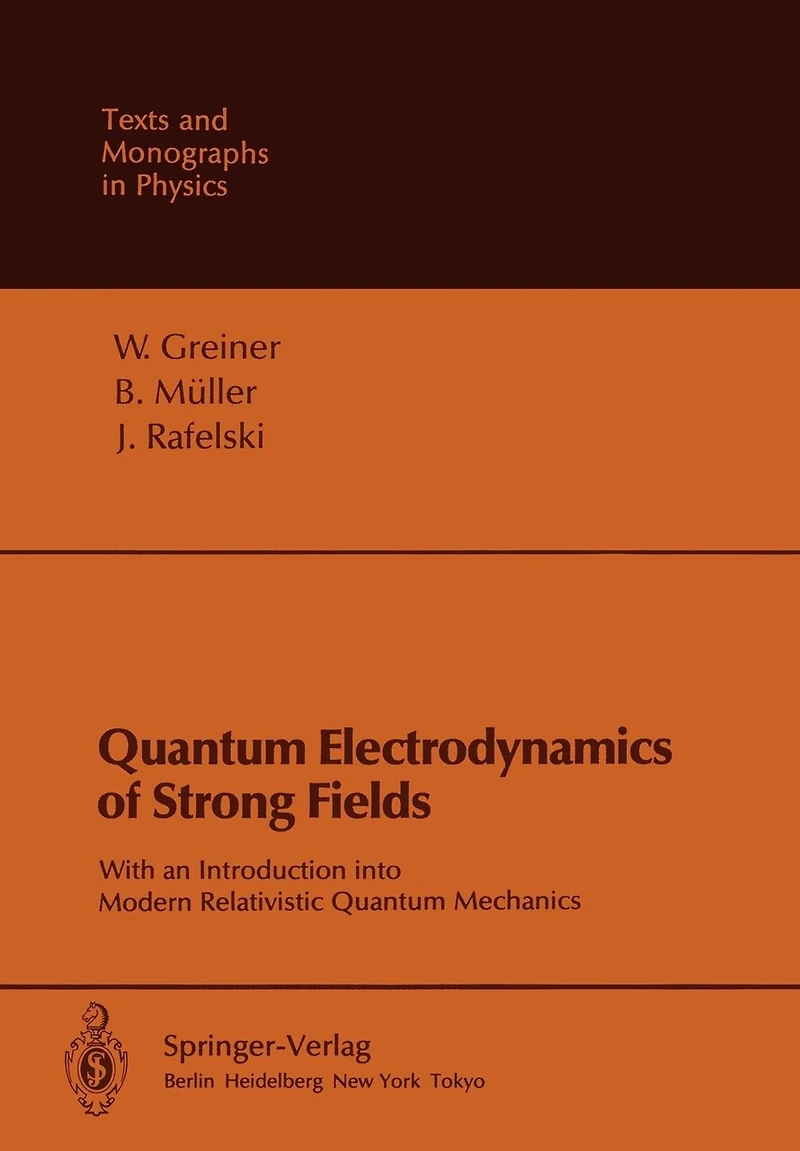
Quantum Electrodynamics of Strong Fields: With an Introduction into Modern Relativistic Quantum Mechanics in Ottawa, ON
Current price: $248.50

Quantum Electrodynamics of Strong Fields: With an Introduction into Modern Relativistic Quantum Mechanics in Ottawa, ON
Current price: $248.50
Loading Inventory...
Size: Paperback
*Product information may vary - to confirm product availability, pricing, shipping and return information please contact Coles
The fundamental goal of physics is an understanding of the forces of nature in their simplest and most general terms. Yet there is much more involved than just a basic set of equations which eventually has to be solved when applied to specific problems. We have learned in recent years that the structure of the ground state of field theories (with which we are generally concerned) plays an equally funda mental role as the equations of motion themselves. Heisenberg was probably the first to recognize that the ground state, the vacuum, could acquire certain prop erties (quantum numbers) when he devised a theory of ferromagnetism. Since then, many more such examples are known in solid state physics, e. g. supercon ductivity, superfluidity, in fact all problems concerned with phase transitions of many-body systems, which are often summarized under the name synergetics. Inspired by the experimental observation that also fundamental symmetries, such as parity or chiral symmetry, may be violated in nature, it has become wide ly accepted that the same field theory may be based on different vacua. Practical ly all these different field phases have the status of more or less hypothetical models, not (yet) directly accessible to experiments. There is one magnificent ex ception and this is the change of the ground state (vacuum) of the electron-posi tron field in superstrong electric fields.
The fundamental goal of physics is an understanding of the forces of nature in their simplest and most general terms. Yet there is much more involved than just a basic set of equations which eventually has to be solved when applied to specific problems. We have learned in recent years that the structure of the ground state of field theories (with which we are generally concerned) plays an equally funda mental role as the equations of motion themselves. Heisenberg was probably the first to recognize that the ground state, the vacuum, could acquire certain prop erties (quantum numbers) when he devised a theory of ferromagnetism. Since then, many more such examples are known in solid state physics, e. g. supercon ductivity, superfluidity, in fact all problems concerned with phase transitions of many-body systems, which are often summarized under the name synergetics. Inspired by the experimental observation that also fundamental symmetries, such as parity or chiral symmetry, may be violated in nature, it has become wide ly accepted that the same field theory may be based on different vacua. Practical ly all these different field phases have the status of more or less hypothetical models, not (yet) directly accessible to experiments. There is one magnificent ex ception and this is the change of the ground state (vacuum) of the electron-posi tron field in superstrong electric fields.
You May Also Like















More About Coles at Bayshore Shopping Centre
Coles is renowned for its outstanding customer service and great selection of books. Along with the vast array of magazines, stationary, audio-books, children's literature, fiction, non-fiction and reference books, you can find accessories to make your reading experience more pleasurable. We can recommend the very best in reading today. We will help you search our titles for exactly what you need, and if we do not have it in stock, we will order it for you.
100 Bayshore Dr, Nepean, ON K2B 8C1, Canada
Find Coles at Bayshore Shopping Centre in Ottawa, ON
Visit Coles at Bayshore Shopping Centre in Ottawa, ON