

Give the Gift of Choice!
Too many options? Treat your friends and family to their favourite stores with a Bayshore Shopping Centre gift card, redeemable at participating retailers throughout the centre. Click below to purchase yours today!Purchase HereHome
The Linear Model and Hypothesis: A General Unifying Theory
Coles
Loading Inventory...
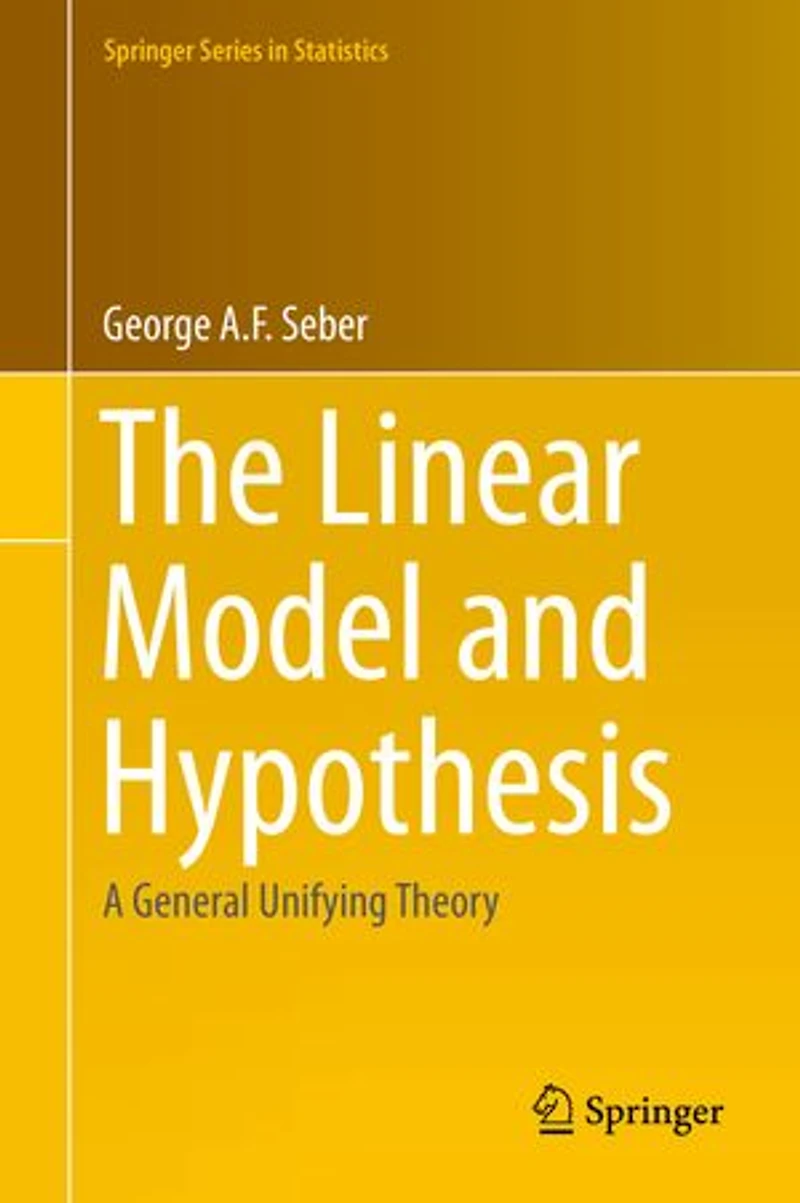
The Linear Model and Hypothesis: A General Unifying Theory in Ottawa, ON
Current price: $70.99
Original price: $88.68

The Linear Model and Hypothesis: A General Unifying Theory in Ottawa, ON
Current price: $70.99
Original price: $88.68
Loading Inventory...
Size: Kobo eBook
*Product information may vary - to confirm product availability, pricing, shipping and return information please contact Coles
This book provides a concise and integrated overview of hypothesis testing in four important subject areas, namely linear and nonlinear models, multivariate analysis, and large sample theory. The approach used is a geometrical one based on the concept of projections and their associated idempotent matrices, thus largely avoiding the need to involvematrix ranks. It is shown that all the hypotheses encountered are either linear or asymptotically linear, and that all the underlying models used are either exactly or asymptotically linear normal models. This equivalence can be used, for example, to extend the concept of orthogonality to other models in the analysis of variance, and to show that the asymptotic equivalence of the likelihood ratio, Wald, and Score (Lagrange Multiplier) hypothesis tests generally applies.
This book provides a concise and integrated overview of hypothesis testing in four important subject areas, namely linear and nonlinear models, multivariate analysis, and large sample theory. The approach used is a geometrical one based on the concept of projections and their associated idempotent matrices, thus largely avoiding the need to involvematrix ranks. It is shown that all the hypotheses encountered are either linear or asymptotically linear, and that all the underlying models used are either exactly or asymptotically linear normal models. This equivalence can be used, for example, to extend the concept of orthogonality to other models in the analysis of variance, and to show that the asymptotic equivalence of the likelihood ratio, Wald, and Score (Lagrange Multiplier) hypothesis tests generally applies.
You May Also Like










More About Coles at Bayshore Shopping Centre
Coles is renowned for its outstanding customer service and great selection of books. Along with the vast array of magazines, stationary, audio-books, children's literature, fiction, non-fiction and reference books, you can find accessories to make your reading experience more pleasurable. We can recommend the very best in reading today. We will help you search our titles for exactly what you need, and if we do not have it in stock, we will order it for you.
100 Bayshore Dr, Nepean, ON K2B 8C1, Canada
Find Coles at Bayshore Shopping Centre in Ottawa, ON
Visit Coles at Bayshore Shopping Centre in Ottawa, ON