

Give the Gift of Choice!
Too many options? Treat your friends and family to their favourite stores with a Bayshore Shopping Centre gift card, redeemable at participating retailers throughout the centre. Click below to purchase yours today!Purchase HereHome
The Transfer-Matrix Method in Electromagnetics and Optics
Coles
Loading Inventory...
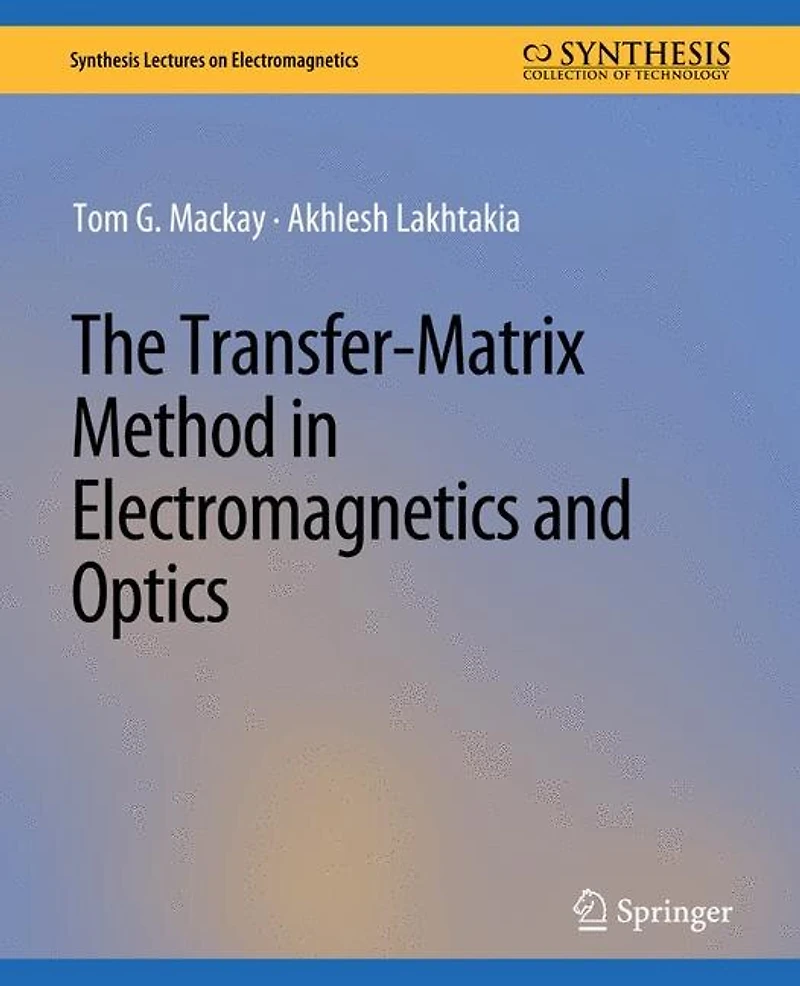
The Transfer-Matrix Method in Electromagnetics and Optics in Ottawa, ON
Current price: $87.95

The Transfer-Matrix Method in Electromagnetics and Optics in Ottawa, ON
Current price: $87.95
Loading Inventory...
Size: Paperback
*Product information may vary - to confirm product availability, pricing, shipping and return information please contact Coles
The transfer-matrix method (TMM) in electromagnetics and optics is a powerful and convenient mathematical formalism for determining the planewave reflection and transmission characteristics of an infinitely extended slab of a linear material. While the TMM was introduced for a homogeneous uniaxial dielectric-magnetic material in the 1960s, and subsequently extended for multilayered slabs, it has more recently been developed for the most general linear materials, namely bianisotropic materials. By means of the rigorous coupled-wave approach, slabs that are periodically nonhomogeneous in the thickness direction can also be accommodated by the TMM. In this book an overview of the TMM is presented for the most general contexts as well as for some for illustrative simple cases. Key theoretical results are given; for derivations, the reader is referred to the references at the end of each chapter. Albums of numerical results are also provided, and the computer code used to generate these results are provided in an appendix.
The transfer-matrix method (TMM) in electromagnetics and optics is a powerful and convenient mathematical formalism for determining the planewave reflection and transmission characteristics of an infinitely extended slab of a linear material. While the TMM was introduced for a homogeneous uniaxial dielectric-magnetic material in the 1960s, and subsequently extended for multilayered slabs, it has more recently been developed for the most general linear materials, namely bianisotropic materials. By means of the rigorous coupled-wave approach, slabs that are periodically nonhomogeneous in the thickness direction can also be accommodated by the TMM. In this book an overview of the TMM is presented for the most general contexts as well as for some for illustrative simple cases. Key theoretical results are given; for derivations, the reader is referred to the references at the end of each chapter. Albums of numerical results are also provided, and the computer code used to generate these results are provided in an appendix.
You May Also Like









More About Coles at Bayshore Shopping Centre
Coles is renowned for its outstanding customer service and great selection of books. Along with the vast array of magazines, stationary, audio-books, children's literature, fiction, non-fiction and reference books, you can find accessories to make your reading experience more pleasurable. We can recommend the very best in reading today. We will help you search our titles for exactly what you need, and if we do not have it in stock, we will order it for you.
100 Bayshore Dr, Nepean, ON K2B 8C1, Canada
Find Coles at Bayshore Shopping Centre in Ottawa, ON
Visit Coles at Bayshore Shopping Centre in Ottawa, ON