

Give the Gift of Choice!
Too many options? Treat your friends and family to their favourite stores with a Bayshore Shopping Centre gift card, redeemable at participating retailers throughout the centre. Click below to purchase yours today!Purchase HereHome
Theoretical Approaches to Non-Numerical Problem Solving: Proceedings of the IV Systems Symposium at Case Western Reserve University
Coles
Loading Inventory...
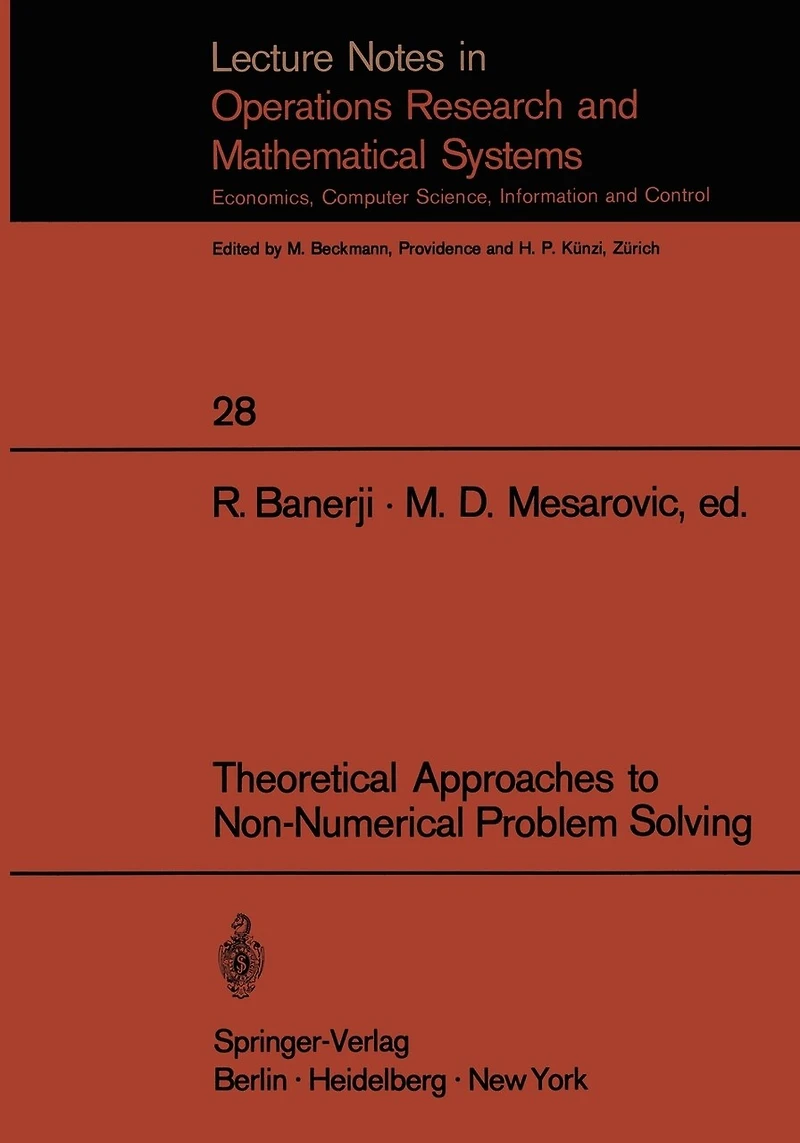
Theoretical Approaches to Non-Numerical Problem Solving: Proceedings of the IV Systems Symposium at Case Western Reserve University in Ottawa, ON
Current price: $142.95

Theoretical Approaches to Non-Numerical Problem Solving: Proceedings of the IV Systems Symposium at Case Western Reserve University in Ottawa, ON
Current price: $142.95
Loading Inventory...
Size: Paperback
*Product information may vary - to confirm product availability, pricing, shipping and return information please contact Coles
Advances in computer technology have pointed out the next important area of computer applications: solution of non-numerical problems. It is hardly necessary to emphasize the importance of these kind of problems. First of all most of the decisions one has to make in real-life situations are non-numerical in the first instance and can be represented as numerical problems only as approximations which are often only partially valid. Second, to use the computer to its full potential it should be employed as a logical machine, capable of deduction, and not just as a numerical calculating machine. Thus the computer would extend man's capability for logical reasoning and not just for his capability to do fast and accurate calculation. It is not a new area; indeed non-numerical problems are central in fields such as artificial intelligence, heuristic programming, pattern recognition, classification and information-processing (and retrival) etc. However, it is fair to assess that progress in the area has not been quite as expected. One of the reasons was a lack of conceptual and theoretical framework in which to investigate different classes of non-numerical problems to improve understanding of various types of problems and methods for their solutions and furthermore to enable the methods which have been proven as effective in one situation to be used in another situation with appropriately similar structure.
Advances in computer technology have pointed out the next important area of computer applications: solution of non-numerical problems. It is hardly necessary to emphasize the importance of these kind of problems. First of all most of the decisions one has to make in real-life situations are non-numerical in the first instance and can be represented as numerical problems only as approximations which are often only partially valid. Second, to use the computer to its full potential it should be employed as a logical machine, capable of deduction, and not just as a numerical calculating machine. Thus the computer would extend man's capability for logical reasoning and not just for his capability to do fast and accurate calculation. It is not a new area; indeed non-numerical problems are central in fields such as artificial intelligence, heuristic programming, pattern recognition, classification and information-processing (and retrival) etc. However, it is fair to assess that progress in the area has not been quite as expected. One of the reasons was a lack of conceptual and theoretical framework in which to investigate different classes of non-numerical problems to improve understanding of various types of problems and methods for their solutions and furthermore to enable the methods which have been proven as effective in one situation to be used in another situation with appropriately similar structure.
You May Also Like












More About Coles at Bayshore Shopping Centre
Coles is renowned for its outstanding customer service and great selection of books. Along with the vast array of magazines, stationary, audio-books, children's literature, fiction, non-fiction and reference books, you can find accessories to make your reading experience more pleasurable. We can recommend the very best in reading today. We will help you search our titles for exactly what you need, and if we do not have it in stock, we will order it for you.
100 Bayshore Dr, Nepean, ON K2B 8C1, Canada
Find Coles at Bayshore Shopping Centre in Ottawa, ON
Visit Coles at Bayshore Shopping Centre in Ottawa, ON