

Give the Gift of Choice!
Too many options? Treat your friends and family to their favourite stores with a Bayshore Shopping Centre gift card, redeemable at participating retailers throughout the centre. Click below to purchase yours today!Purchase HereHome
tp1.2 A continuing inquiry into the Foundations of the Science of Physics: Vector Algebra
Coles
Loading Inventory...
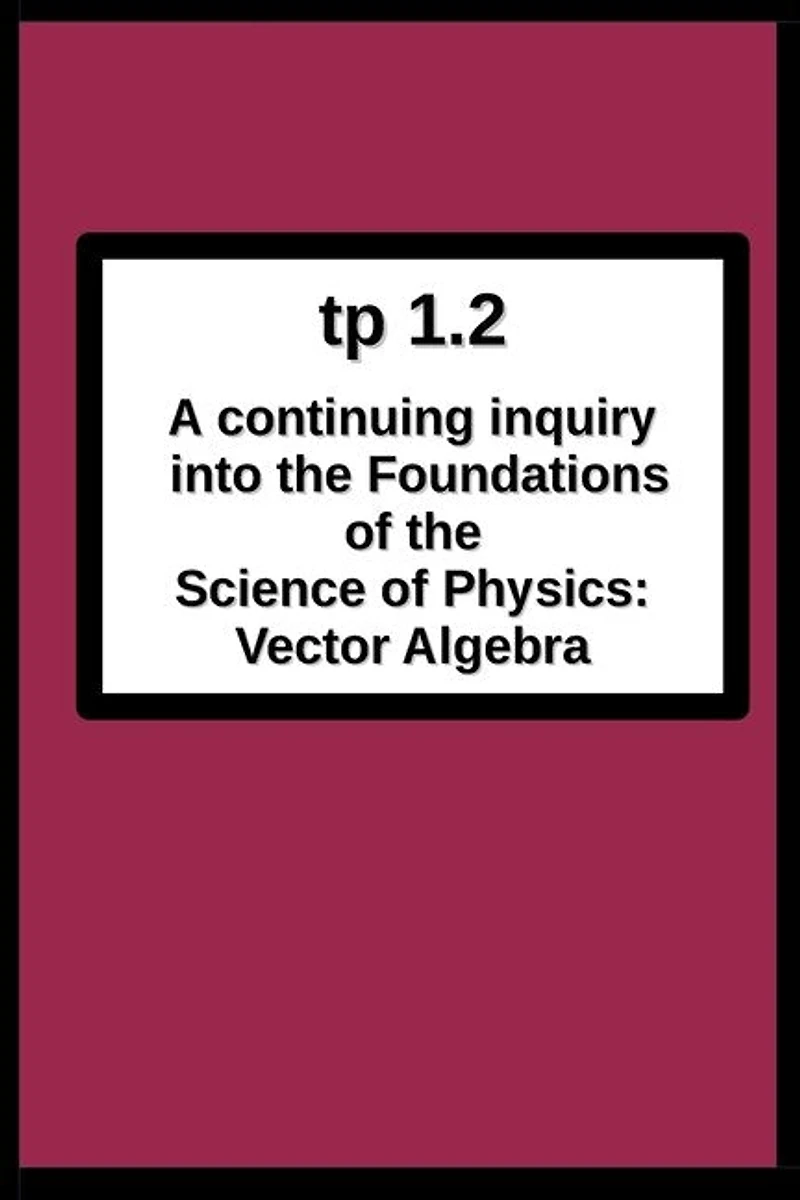
tp1.2 A continuing inquiry into the Foundations of the Science of Physics: Vector Algebra in Ottawa, ON
Current price: $22.00

tp1.2 A continuing inquiry into the Foundations of the Science of Physics: Vector Algebra in Ottawa, ON
Current price: $22.00
Loading Inventory...
Size: Paperback
*Product information may vary - to confirm product availability, pricing, shipping and return information please contact Coles
Physics, as a science, must be able to describe the location of material objects, their movements, and the forces involved. Following on tp1.1, this work addresses the task of location starting with the mathematical objects in a three dimensional set of vectors. The reader is taken as intelligent, interested in Physics, but perhaps without a strong foundation in Mathematics. The topic is developed as a dialog between three friends. While addition in the set of vectors is given axiomatically, the operation itself is not formulated, a proper formulation of which the friends finally accept. The interplay between geometry and algebra becomes part of the discussion. Subtraction, not axiomatic, follows. Three types of multiplication become apparent (inner, cross, outer). Their various combinations are summarized in a large table of vectorial identities. With the definition of division in the set of vectors, the friends recognize that they have constructed an algebra . With an algebra comes equations, and the quest for solutions. The friends, with no little difficulty, find all solutions of vectorial algebraic equations which they display in a second table. Matrices are introduced, so also equations with matrices. The friends find comprehensive solutions for these, both for the unknown vector, and for the matrix itself. These mathematical constructions, however, cannot apply directly to science of Physics. The friends discuss what restrictions need to be made, and how the restricted structures may then be made into a proper instrument for describing physical locations. The restrictions involve material and spatial references which result in a fundamental duality in observation and the important physical principle of non-collocation. The Foundation for Theoretical Physics is dedicated to advancing a science of Physics without contradictions.
Physics, as a science, must be able to describe the location of material objects, their movements, and the forces involved. Following on tp1.1, this work addresses the task of location starting with the mathematical objects in a three dimensional set of vectors. The reader is taken as intelligent, interested in Physics, but perhaps without a strong foundation in Mathematics. The topic is developed as a dialog between three friends. While addition in the set of vectors is given axiomatically, the operation itself is not formulated, a proper formulation of which the friends finally accept. The interplay between geometry and algebra becomes part of the discussion. Subtraction, not axiomatic, follows. Three types of multiplication become apparent (inner, cross, outer). Their various combinations are summarized in a large table of vectorial identities. With the definition of division in the set of vectors, the friends recognize that they have constructed an algebra . With an algebra comes equations, and the quest for solutions. The friends, with no little difficulty, find all solutions of vectorial algebraic equations which they display in a second table. Matrices are introduced, so also equations with matrices. The friends find comprehensive solutions for these, both for the unknown vector, and for the matrix itself. These mathematical constructions, however, cannot apply directly to science of Physics. The friends discuss what restrictions need to be made, and how the restricted structures may then be made into a proper instrument for describing physical locations. The restrictions involve material and spatial references which result in a fundamental duality in observation and the important physical principle of non-collocation. The Foundation for Theoretical Physics is dedicated to advancing a science of Physics without contradictions.
You May Also Like










More About Coles at Bayshore Shopping Centre
Coles is renowned for its outstanding customer service and great selection of books. Along with the vast array of magazines, stationary, audio-books, children's literature, fiction, non-fiction and reference books, you can find accessories to make your reading experience more pleasurable. We can recommend the very best in reading today. We will help you search our titles for exactly what you need, and if we do not have it in stock, we will order it for you.
100 Bayshore Dr, Nepean, ON K2B 8C1, Canada
Find Coles at Bayshore Shopping Centre in Ottawa, ON
Visit Coles at Bayshore Shopping Centre in Ottawa, ON