

Give the Gift of Choice!
Too many options? Treat your friends and family to their favourite stores with a Bayshore Shopping Centre gift card, redeemable at participating retailers throughout the centre. Click below to purchase yours today!Purchase HereHome
Translation of Comics. Using the Example of "Superman"
Coles
Loading Inventory...
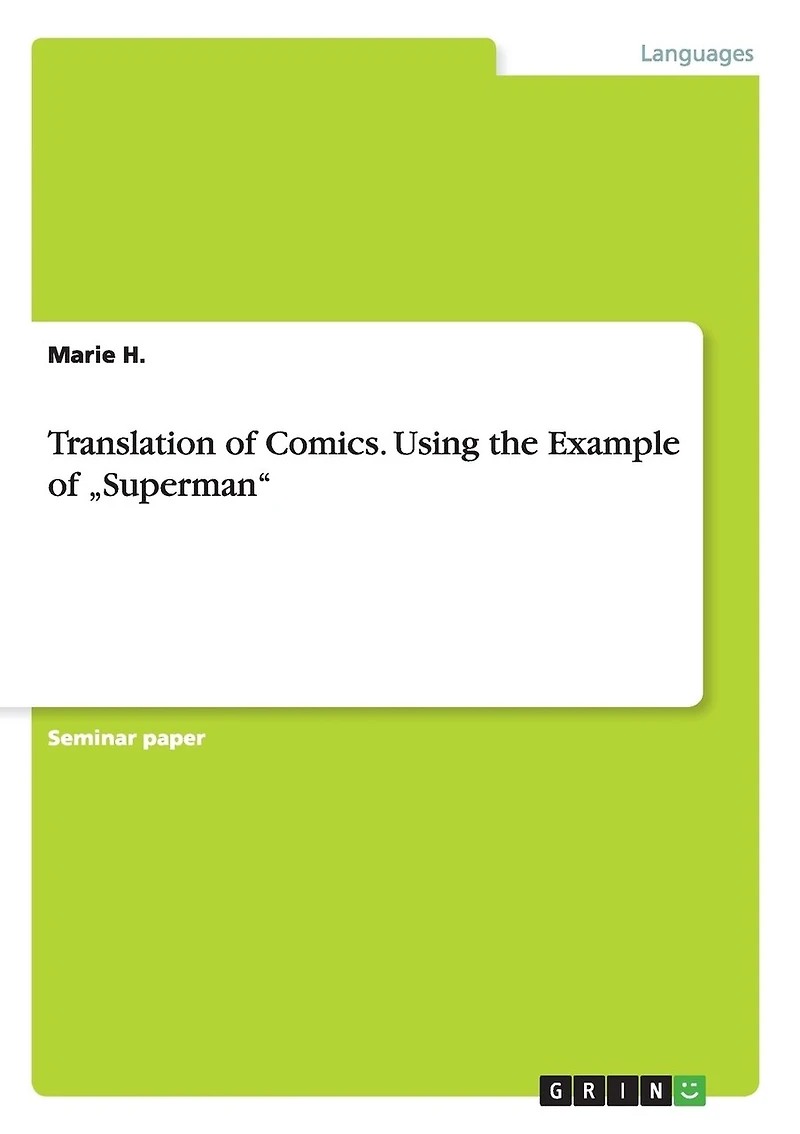
Translation of Comics. Using the Example of "Superman" in Ottawa, ON
Current price: $33.50

Translation of Comics. Using the Example of "Superman" in Ottawa, ON
Current price: $33.50
Loading Inventory...
Size: Paperback
*Product information may vary - to confirm product availability, pricing, shipping and return information please contact Coles
Seminar paper from the year 2015 in the subject Literature - Modern Literature, grade: 2,3, RWTH Aachen University (Anglistik), course: Translation Studies, language: English, abstract: Comics are "texts organised into sequential units, graphically separated from each other" (Saraceni 2003: 5) and "employ [...] both words and pictures" (ibid.). First, American comics were translated and pirated versions of works done by Rodolphe Töpffer, a Swiss illustrator (cf. Duncan, Smith 2009: 25). In 1895, Richard F. Outcault published funny illustrations in the Sunday edition of Pulitzer's New York World, focusing on the New York Slums (cf. Schröder 1982: 12). "Hogan's Alley" soon became a popular weekly series featuring a little boy as the protagonist: The Yellow Kid, named after the accidentally "new" color of its nightgown (cf. ibid.). Outcault experimented with panels and word balloons, switching "back and forth from Victorian to modern comic styles" (Petersen 2011: 98). The Yellow Kid polarized the newspaper audience: on the one hand, people started anti-comic campaigns; on the other hand, it became a huge success for Pulitzer (cf. Schröder 1982: 12-13). However, Pulitzer's success through The Yellow Kid led to a war between him and William R.
Seminar paper from the year 2015 in the subject Literature - Modern Literature, grade: 2,3, RWTH Aachen University (Anglistik), course: Translation Studies, language: English, abstract: Comics are "texts organised into sequential units, graphically separated from each other" (Saraceni 2003: 5) and "employ [...] both words and pictures" (ibid.). First, American comics were translated and pirated versions of works done by Rodolphe Töpffer, a Swiss illustrator (cf. Duncan, Smith 2009: 25). In 1895, Richard F. Outcault published funny illustrations in the Sunday edition of Pulitzer's New York World, focusing on the New York Slums (cf. Schröder 1982: 12). "Hogan's Alley" soon became a popular weekly series featuring a little boy as the protagonist: The Yellow Kid, named after the accidentally "new" color of its nightgown (cf. ibid.). Outcault experimented with panels and word balloons, switching "back and forth from Victorian to modern comic styles" (Petersen 2011: 98). The Yellow Kid polarized the newspaper audience: on the one hand, people started anti-comic campaigns; on the other hand, it became a huge success for Pulitzer (cf. Schröder 1982: 12-13). However, Pulitzer's success through The Yellow Kid led to a war between him and William R.
You May Also Like










More About Coles at Bayshore Shopping Centre
Coles is renowned for its outstanding customer service and great selection of books. Along with the vast array of magazines, stationary, audio-books, children's literature, fiction, non-fiction and reference books, you can find accessories to make your reading experience more pleasurable. We can recommend the very best in reading today. We will help you search our titles for exactly what you need, and if we do not have it in stock, we will order it for you.
100 Bayshore Dr, Nepean, ON K2B 8C1, Canada
Find Coles at Bayshore Shopping Centre in Ottawa, ON
Visit Coles at Bayshore Shopping Centre in Ottawa, ON