

Give the Gift of Choice!
Too many options? Treat your friends and family to their favourite stores with a Bayshore Shopping Centre gift card, redeemable at participating retailers throughout the centre. Click below to purchase yours today!Purchase HereHome
Underhill's and Mason's account of the Pequot War compared to Philip Vincent, "A True Relation of the Late Battell Fought in New England": And Representations of the Pequots and the Pequot War
Coles
Loading Inventory...
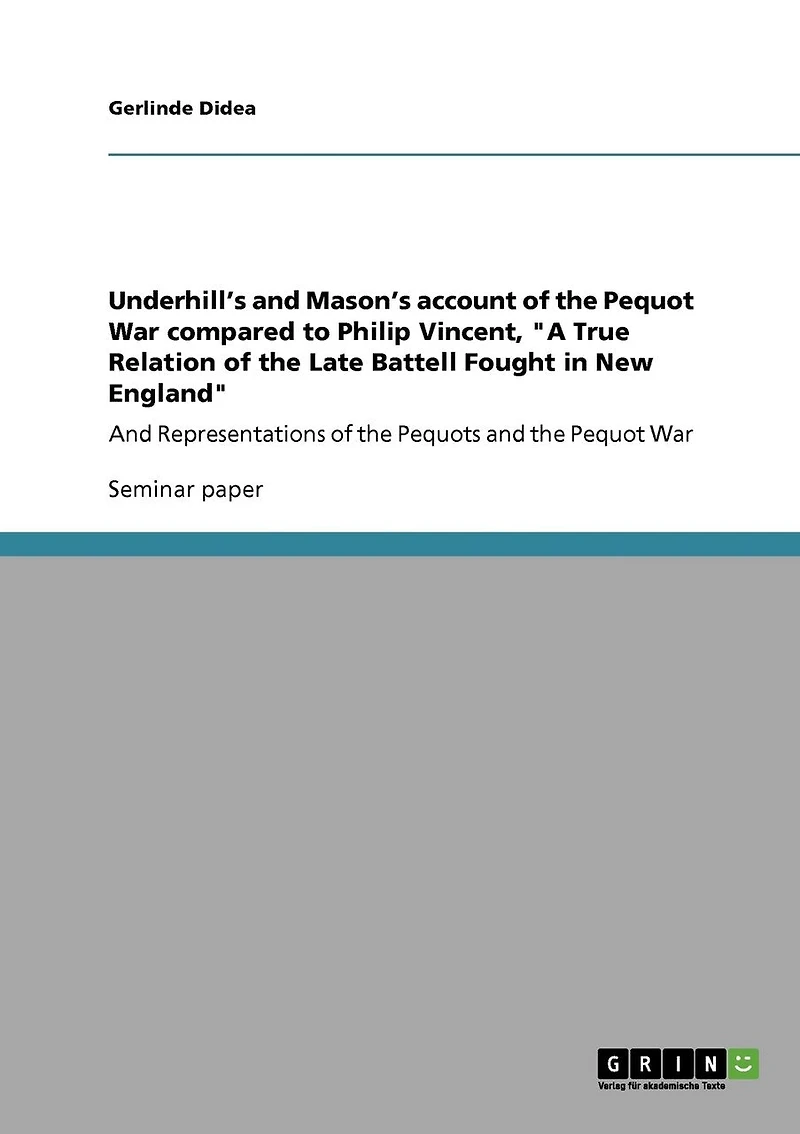
Underhill's and Mason's account of the Pequot War compared to Philip Vincent, "A True Relation of the Late Battell Fought in New England": And Representations of the Pequots and the Pequot War in Ottawa, ON
Current price: $33.50

Underhill's and Mason's account of the Pequot War compared to Philip Vincent, "A True Relation of the Late Battell Fought in New England": And Representations of the Pequots and the Pequot War in Ottawa, ON
Current price: $33.50
Loading Inventory...
Size: Paperback
*Product information may vary - to confirm product availability, pricing, shipping and return information please contact Coles
Seminar paper from the year 2007 in the subject American Studies - Literature, grade: 2, Johannes Gutenberg University Mainz, course: Seminar Fighting Words, language: English, abstract: In 1637, the English colonists had already had several encounters with the native inhabitants of New England. Most of them had taken place in a peaceful manner, with the exception of their encounter with the Pequots. Despite great efforts to negotiate for peaceful coexistence, the Pequots occasionally committed sudden assaults on the English colonists and thereby broke mutual agreements. The increasing Pequot aggressiveness soon exhausted the English endurance. As a consequence, the English decide to counterattack. John Mason, who commanded the Connecticut forces, focuses on the causes of war, while Captain John Underhill, commander of the Massachusetts Bay forces, relies on his theory of the successful massacre at God's interaction. As a contemporary narrator, Philip Vincent relates on information of people who witnessed the occurrences. The applied cruelty and systematic annihilation of almost the whole Pequot tribe, of course, raise the question about justification of the reasons. Is it providence, as Underhill interprets it, that the Pequots were so cruelly attacked? Is it an act of self-preservation as Mason concludes? Or did the Pequots deserve to be massacred for their tenacious aggressiveness and insult against the English as Vincent claims? It is a fact that Mason, Underhill as well as Vincent endorse and defend the massacre from their own point of view. Since all three narratives are from the first-person point of view, the interpretations of the Pequot massacre are biased and reflect individual reasons and emotions. Religious-based racism using the Christian bible as reference; desperation and anger are the sources of the cruelty of the massacre. The strong desire for vengeance and the quest for Puritan identity cause the English describe the Pequots as God's tool.
Seminar paper from the year 2007 in the subject American Studies - Literature, grade: 2, Johannes Gutenberg University Mainz, course: Seminar Fighting Words, language: English, abstract: In 1637, the English colonists had already had several encounters with the native inhabitants of New England. Most of them had taken place in a peaceful manner, with the exception of their encounter with the Pequots. Despite great efforts to negotiate for peaceful coexistence, the Pequots occasionally committed sudden assaults on the English colonists and thereby broke mutual agreements. The increasing Pequot aggressiveness soon exhausted the English endurance. As a consequence, the English decide to counterattack. John Mason, who commanded the Connecticut forces, focuses on the causes of war, while Captain John Underhill, commander of the Massachusetts Bay forces, relies on his theory of the successful massacre at God's interaction. As a contemporary narrator, Philip Vincent relates on information of people who witnessed the occurrences. The applied cruelty and systematic annihilation of almost the whole Pequot tribe, of course, raise the question about justification of the reasons. Is it providence, as Underhill interprets it, that the Pequots were so cruelly attacked? Is it an act of self-preservation as Mason concludes? Or did the Pequots deserve to be massacred for their tenacious aggressiveness and insult against the English as Vincent claims? It is a fact that Mason, Underhill as well as Vincent endorse and defend the massacre from their own point of view. Since all three narratives are from the first-person point of view, the interpretations of the Pequot massacre are biased and reflect individual reasons and emotions. Religious-based racism using the Christian bible as reference; desperation and anger are the sources of the cruelty of the massacre. The strong desire for vengeance and the quest for Puritan identity cause the English describe the Pequots as God's tool.
You May Also Like







More About Coles at Bayshore Shopping Centre
Coles is renowned for its outstanding customer service and great selection of books. Along with the vast array of magazines, stationary, audio-books, children's literature, fiction, non-fiction and reference books, you can find accessories to make your reading experience more pleasurable. We can recommend the very best in reading today. We will help you search our titles for exactly what you need, and if we do not have it in stock, we will order it for you.
100 Bayshore Dr, Nepean, ON K2B 8C1, Canada
Find Coles at Bayshore Shopping Centre in Ottawa, ON
Visit Coles at Bayshore Shopping Centre in Ottawa, ON